
-3.png?width=50&name=Square%20(2)-3.png)

Yes, but not in the way most headlines suggest. PwC's 2026 AI Jobs Barometer found Singapore employers advertise pay up to 107% higher for roles requiring AI skills in the public sector. That number compares job postings against each other, not your salary before and after a course, and Singapore's own workforce data tells a far more cautious story.
What does PwC's "AI wage premium" actually measure?
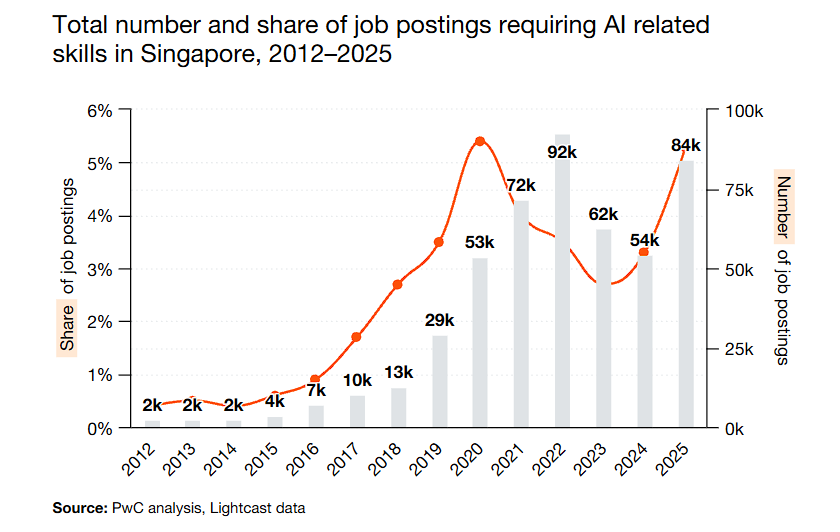
Every June, PwC's Global AI Jobs Barometer analyses roughly a billion job postings worldwide, including 1.6 million in Singapore alone, and produces a number that gets recycled across recruitment sites, salary guides and LinkedIn posts for the rest of the year. The 2026 edition put Singapore's Government and Public Sector wage premium for AI-related roles at 107%, with Consumer Markets close behind at 96%.
PwC defines this premium as the gap between average advertised wages in job postings that require AI skills and average advertised wages in postings that do not, within the same sector. It is a snapshot comparing two sets of job adverts, not a study tracking one worker's pay before and after picking up an AI skill.
Globally, the pattern flips in a genuinely odd way. PwC's worldwide average wage premium sits at 62% (up from 57% the year before), ranging from 118% in consumer markets down to just 16% in government and public sector roles. Singapore's public sector premium runs in the opposite direction: the highest of any local sector, not the lowest.
Why doesn't a bigger premium mean a bigger raise for you?
PwC's own explanation is instructive here. Premiums run highest where AI-related hiring concentrates in a small pool of specialised roles, and stay more contained where AI fluency has already become a baseline expectation across many job ads. A wide gap can simply mean fewer AI-tagged postings exist in that sector, not that anyone who adds "ChatGPT" to a CV is due a six-figure jump.
What does Singapore's own workforce data actually show?
Singapore's government is not waiting to find out. PM Wong now personally chairs a new National AI Council, overseeing a National AI Impact Programme and sector-specific AI missions built to push adoption from pilot to national scale.
The ground-level picture lags that ambition. The Ministry of Manpower's Adoption of Artificial Intelligence Among Firms survey, fielded across 2,560 establishments between January and March 2026, found that 71.5% of Singapore firms have not started adopting AI at all. Among the 28.5% that have, only 3.8% have integrated it into core processes; most are still piloting or planning.
Displacement fears are also running ahead of the evidence. Just 6.2% of adopting firms reported cutting headcount because of AI. Far more common outcomes were redesigning existing job roles (18.9%) and creating new AI-related positions (13.9%), pointing to a labour market being reshaped rather than emptied out.
Adoption is also uneven. It rises from 23.9% among firms with under 25 staff to 76.4% among those with 500-plus, and concentrates in Information and Communications (74.1%), Professional Services (57.5%) and Financial Services (56.4%), against just 21.9% in Food and Beverage. Despite ranking third globally on digital competitiveness, Singapore still trails Denmark, Finland and Sweden on firm-level AI adoption.
So should you spend money learning AI skills right now?
Treat the wage premium headline as directional, not personal. Every sector PwC surveyed does place some premium on AI-related roles, so the underlying signal is real. But the size of any one sector's number says more about how scarce and specialised those roles currently are than about what awaits you personally after a weekend course. It is also the exact question TFC's Wise & Shine team put to a recruiter, an academic and a career consultant on its Budget 2026 special, where the question was debated directly rather than assumed.
A more useful question is whether your own sector is actually adopting AI yet, per MOM's data, since that is what eventually turns demand into pay differentiation. Tech, finance and professional services fluency compounds fastest. Retail and F&B are moving too, just later.
Since SkillsFuture credits and WSG's Career Conversion Programmes keep the cost low, as TFC has previously unpacked, an AI course is cheap optionality, not a guaranteed payout. The more durable form of human development, per PwC's own findings, is judgement, leadership and client trust, the real dividing line between roles that get a raise and roles that get automated.
In summary
Singapore's AI wage premiums are real but easy to misread. They measure differences between job adverts, not your own career trajectory, and MOM's own data shows most local firms have barely started adopting AI at all. Watch your sector's actual adoption rate, not the headline percentage, before deciding how much to spend chasing it.
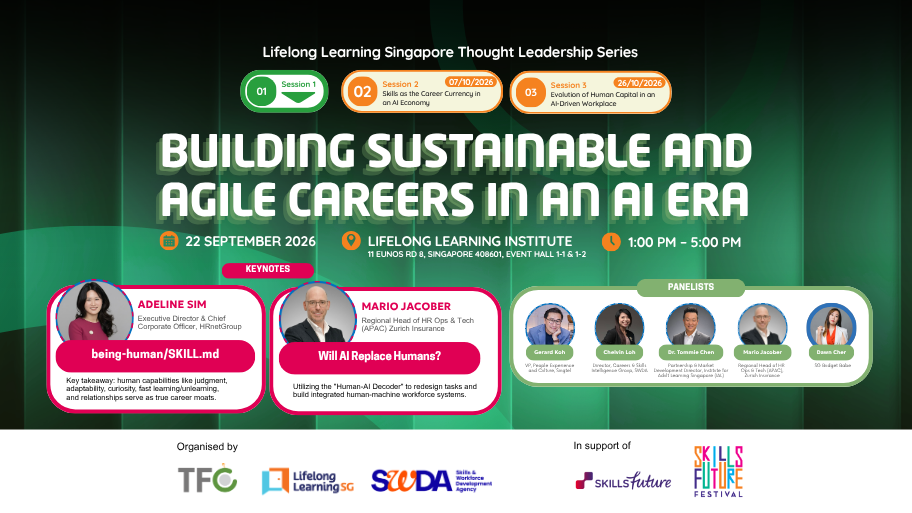
For more breakdowns of what Singapore's economic data actually means for your career and money, follow The Financial Coconut Podcast, join the community via linkin.bio/thefinancialcoconut, or reserve a seat at TFC's Thought Leadership Series with Lifelong Learning Singapore on how careers, skills and organisations are being reshaped by AI.
FAQ
-
Does learning AI skills guarantee a pay rise in Singapore?
No. PwC's wage premium figures compare average advertised salaries between job postings that require AI skills and those that don't within the same sector. They do not track any individual worker's pay before and after gaining an AI skill, so there is no guaranteed personal payout attached to the headline number. -
What is PwC's AI wage premium for Singapore in 2026?
PwC's 2026 Global AI Jobs Barometer found a 107% wage premium for AI-related roles in Singapore's Government and Public Sector and 96% in Consumer Markets, both well above the global average of 62%. -
Have most Singapore companies actually adopted AI?
No. MOM's Adoption of Artificial Intelligence Among Firms survey, fielded January to March 2026, found 71.5% of firms have not started adopting AI, and only 3.8% have integrated it into core business processes. -
Is AI actually replacing jobs in Singapore right now?
Not on current evidence. Only 6.2% of firms that adopted AI reported cutting headcount because of it. Redesigning existing roles (18.9%) and creating new AI-related positions (13.9%) were far more common outcomes.
Reference
- PwC Singapore, 2026 Global AI Jobs Barometer – Singapore edition
- PwC Global, AI reshapes global labour market into two distinct paths, rewarding human skills: PwC 2026 Global AI Jobs Barometer
- Ministry of Manpower, Adoption of Artificial Intelligence Among Firms
Let us know what you think about this topic, and what do you want to hear next.
You can now be our community contributor and make a pitch to have your favourite personality be on our show.
Join our community group and drop us your insights on this topic.






Let us know what you think of this post