
-3.png?width=50&name=Square%20(2)-3.png)

TL;DR
- October 2026's SSB (SBOCT26) pays 1.65% in year one and 2.32% on average over ten years, the best since August 2025.
- The latest 6-month T-bill yields 1.6% (just below SSB's year-one rate); the latest 1-year T-bill yields 1.68% (just above it).
- T-bills still edge out SSB for a straight one-year lock-up; SSB wins on penalty-free flexibility and on longer holding periods.
- CPF's OA (2.5%) and SMRA (4%) rates still beat both for money you will not touch before retirement.
The October 2026 Singapore Savings Bond (SBOCT26) pays 1.65% in its first year and 2.32% a year on average over ten years, the highest since August 2025. That is a real jump from September's tranche, but it does not automatically make SSB the better parking spot for cash than T-bills. The right call still depends on how long you can leave the money untouched.
What are the new SSB rates?
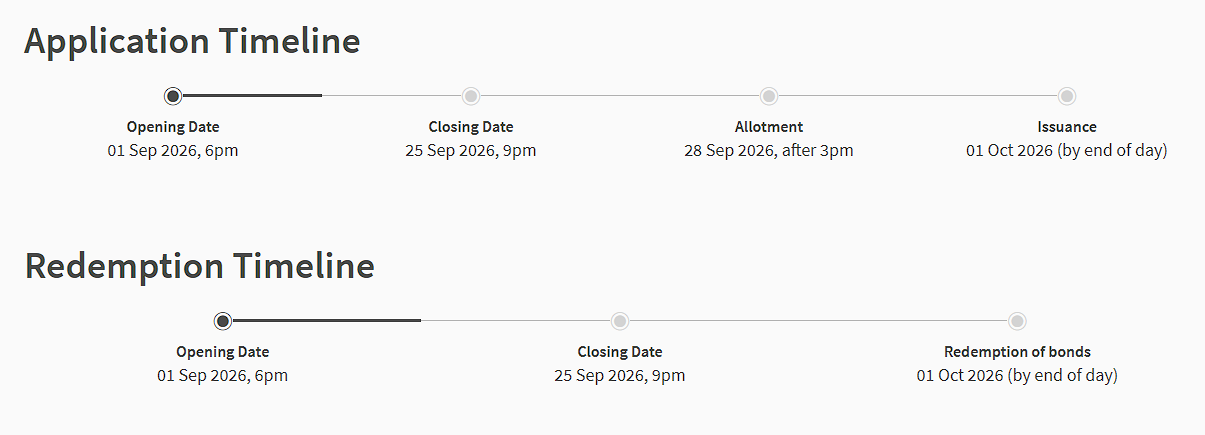
MAS announces each month's Savings Bond details on the first business day of the month. October 2026's tranche landed at:
- Year 1 rate: 1.65% per annum
- 10-year average return: 2.32% per annum
That is up from September's SBSEP26 (1.52% year one, 2.25% average), and the strongest since SBAUG25 in August 2025 (1.82% year one, 2.29% average). Yields had slid to a cycle low with SBNOV25 in November 2025, just 1.39% for year one. October really is a 14-month high.
How does this stack up against T-bills?
Here is where the "SSB beats T-bills" headline needs a caveat. The latest 6-month T-bill (BS26117A, issued 1 September 2026) cleared at a 1.6% cut-off yield, per MAS's own data, its highest in 2026, but still just below SSB's 1.65% first-year rate.
The 1-year T-bill tells a different story: the most recent 1-year auction (BY26102T, 23 July 2026) cleared at 1.68%, a touch above what SSB pays in year one. So for a straight one-year lock-up, T-bills currently edge out SSB on rate alone.
Where SSB pulls ahead is over the longer haul. Its 2.32% ten-year average beats both T-bill tenors comfortably, because SSB steps up its coupon over time rather than fixing one short-term rate.
Which one should you actually use?
It comes down to liquidity, not yield alone. Need the cash back within six to twelve months? T-bills remain competitive, and the 1-year tenor currently pays marginally more than SSB's year-one rate. Might need it earlier but want flexibility? SSB redeems any month without penalty, losing only that month's interest, unlike a T-bill locked until maturity. Can leave it for several years? SSB's step-up structure and 2.32% average become the stronger option, assuming rates do not climb sharply from here.
Worth remembering: CPF's Ordinary Account still pays a base 2.5%, and the Special, MediSave and Retirement Accounts pay 4%, as covered in our recent breakdown of why CPF now pays more than T-bills and savings bonds. For money you will not touch before retirement, that comparison still outweighs the SSB-versus-T-bill debate.
None of this argues against diversification. SSBs work best as one part of a broader short-to-medium-term cash strategy, a point explored further in TFC's guide to the role of Singapore Savings Bonds in a diversified portfolio, alongside TFC's comparison of T-bills against other short-term investments.
In summary
October's SSB pays 1.65% in year one and 2.32% on average over ten years, its best showing in 14 months, but it does not cleanly beat T-bills across the board. The 1-year T-bill still pays marginally more for a one-year lock-up, while SSB wins on flexibility and long-term average. Match the instrument to when you actually need the cash back, not to whichever headline rate looks highest this month.
For more timely breakdowns like this one, follow The Financial Coconut Podcast and join the community via linkin.bio/thefinancialcoconut.
FAQ
-
What is the interest rate for the October 2026 Singapore Savings Bond?
SBOCT26 pays 1.65% per annum in year one and 2.32% per annum on average over ten years, the highest SSB rate since August 2025. -
Is SSB better than T-bills right now?
It depends on your timeframe. The latest 6-month T-bill yields 1.6%, just below SSB's 1.65% year-one rate, while the latest 1-year T-bill yields 1.68%, just above it. SSB pulls ahead over a longer holding period thanks to its step-up structure. -
Can I redeem Singapore Savings Bonds early without penalty?
Yes. SSBs can be redeemed in any month without penalty, though you lose that month's accrued interest. T-bills, by contrast, are locked until maturity unless sold on the secondary market. -
Why did SSB yields fall so low in late 2025 before recovering?
SSB yields track expected future Singapore government bond yields. The cycle low came with SBNOV25 at 1.39%, before recovering through 2026 to October's 1.65%.
References
-
What is the cut-off yield of the latest T-bill? Monetary Authority of Singapore, What is the cut-off yield of the latest T-bill?
-
Singapore Savings Bonds Monetary Authority of Singapore, Singapore Savings Bonds
- SBOCT26 GX26100Z Bond Details Monetary Authority of Singapore, Singapore Savings Bonds
-
CPF interest rates from 1 July to 30 September 2026 CPF Board, CPF interest rates from 1 July to 30 September 2026
Let us know what you think about this topic, and what do you want to hear next.
You can now be our community contributor and make a pitch to have your favourite personality be on our show.
Join our community group and drop us your insights on this topic.




Let us know what you think of this post