
-3.png?width=50&name=Square%20(2)-3.png)

Singapore's average pay rise has gotten smaller since generative AI became part of daily work, not bigger. Nominal wage growth peaked at 6.5% in 2022, then eased to 5.2% in 2023 and 4.9% in 2025. Yet AI-skilled roles are commanding premiums of 15% to 40% over the same stretch. The money didn't disappear. It moved.
What actually happened to Singapore's pay before and after AI went mainstream?
MOM's Report on Wage Practices tracks nominal total wages (basic pay, bonuses and employer CPF) for full-time resident employees with the same employer for at least a year. The recent trend:
- 2019: 3.9%
- 2020: 1.2% (pandemic hit)
- 2021: 3.9%
- 2022: 6.5%, the highest in a decade
- 2023: 5.2%
- 2024: 5.6%
- 2025: 4.9%
- 2026: 4.0% to 4.3% (forecast)
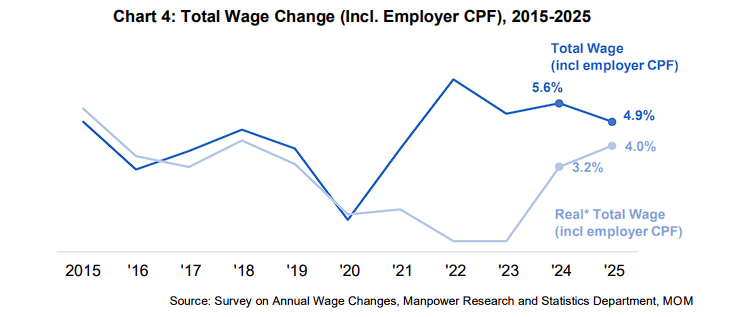
ChatGPT only went public in late November 2022, and most workplaces didn't have AI tools in daily use until 2023, so that 2022 peak sits just before the AI wave, not because of it. Wage growth has broadly cooled since, most clearly in 2025 and the 2026 outlook.
Why is overall wage growth slowing while AI adoption is rising?
Because fewer companies are giving everyone a raise, and the ones that do are choosier about where it lands. MOM's 2025 report found 72.4% of firms raised wages, down from 78.3% in 2024, while the share holding pay flat rose from 18.5% to 24.5%. Among firms that did raise pay, the average increment was still 5.8%.
The budget hasn't shrunk. It's being redirected. Reeracoen's 2026 Salary Guide frames this as a shift from tenure-based to value-based pay, with base salaries growing slower while variable pay and skill-linked increments take a bigger share.
Where is the AI salary premium actually showing up?
For workers who can put AI to work, the numbers look nothing like the average.
- Junior engineers (zero to two years) with AI skills earned S$6,000 a month at the median in 2026, 25% more than peers without those skills, per NodeFlair's Singapore Tech Salary Report.
- AI and machine learning specialists typically earn 15% to 30% more than generalist engineers at the same seniority; Mercer's 2026 forecast puts some AI/ML premiums as high as 20% to 40%.
- Technology, AI and sustainability-linked roles are seeing pay rises of 6% to 18%, well above the roughly 4% average increment forecast for 2026.
- The sharpest premium isn't always in an "AI" job title. Hybrid roles blending AI into an existing function, like data engineering or growth marketing, are growing pay two to three times faster than their parent function, because the value sits in applying AI inside a real workflow.
What's happening to pay in roles without an AI edge?
This isn't purely a top-versus-bottom story. MOM's own 2026 assessment found real median incomes grew 8.3% between 2020 and 2025, and lower-wage workers saw real incomes grow even faster, at 15%, largely thanks to the Progressive Wage Model. The divide sits more within income bands: NodeFlair found average pay growth of 12.6% for senior engineers and 11.6% for lead roles, against just 1.7% for mid-level roles, a gap too wide to explain by seniority alone. It looks like companies paying up for people who can already work with AI, while everyone else waits for their own skills to catch up.
So did AI help or hurt Singapore salaries?
Neither, exactly. AI hasn't changed how much total money employers put into pay; if anything, that pool has grown more cautiously since 2022. What's changed is how it's allocated. If your role touches AI, you're likely on the faster-growing side of a widening gap. If it doesn't, your raise probably still arrived, just smaller than it might have looked before AI.
What can you actually do about it?
The AI premium rewards applied skill, not a computer science degree. Singapore's policy response reflects that: SkillsFuture Singapore and Workforce Singapore merged into a single Skills and Workforce Development Agency in July 2026, and the new Tripartite Jobs Council is focused on helping workers build AI-ready skills rather than compete against AI cold.
How you reposition your career, rather than worry about it, is what The Financial Coconut's Wise & Shine episode on the traits that make mid-career professionals irreplaceable digs into, alongside its look at whether Singaporeans are still hireable in an AI-shaped market.
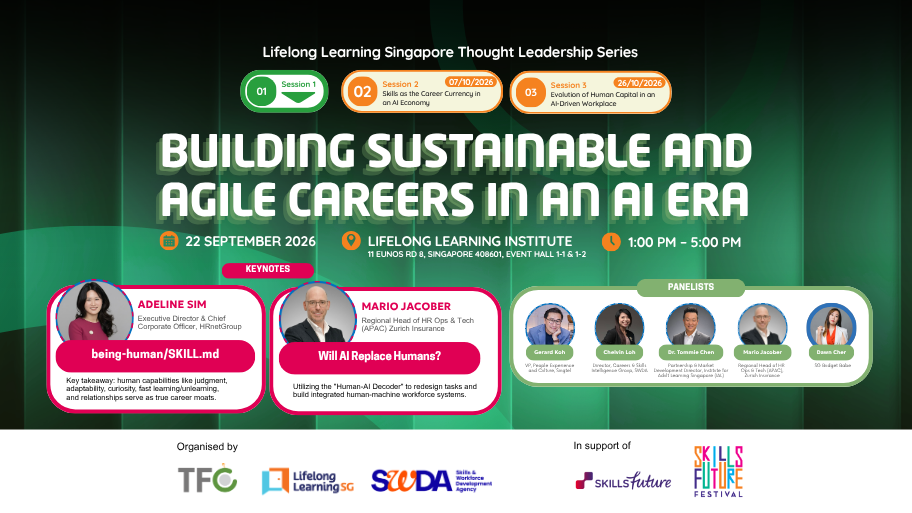
If you'd rather work through it with others navigating the same shift, The Financial Coconut has partnered with Lifelong Learning Singapore on a three-part Thought Leadership Series built around exactly this: how individuals are pivoting, what markets value in candidates, and how organisations are redesigning roles. The first session, Building Sustainable and Agile Careers in an AI Era, runs on 22 September 2026.
In summary
Singapore's average pay rise has genuinely slowed since AI became part of daily work, from a decade-high 6.5% in 2022 to a forecast 4.0% to 4.3% in 2026. For workers who can operationalise AI, premiums of 15% to 40% tell a different story. That gap, not a uniform AI pay boom, is the real story of Singapore salaries right now.
For more breakdowns on how Singapore's economy is reshaping your income, follow The Financial Coconut and join the community via linkin.bio/thefinancialcoconut.
FAQ
-
Has AI actually raised average salaries in Singapore?
Not across the board. MOM data shows nominal wage growth peaked at 6.5% in 2022, before generative AI was in daily workplace use, and has since eased to 4.9% in 2025 and a forecast 4.0% to 4.3% in 2026. The gains have concentrated in specific roles rather than lifting the average. -
How much more can AI-skilled workers earn in Singapore?
Reports point to premiums of roughly 15% to 40%, depending on role and seniority. NodeFlair's 2026 tech salary data found junior engineers with AI skills earning S$6,000 a month at the median, 25% more than peers without those skills. -
Why is Singapore's overall wage growth slowing if AI is meant to boost productivity?
MOM's 2025 wage report found fewer firms gave increases (72.4%, down from 78.3% in 2024) and more kept pay unchanged (24.5%, up from 18.5%). Companies appear to be redirecting a larger share of increment budgets toward AI-linked skills rather than spreading raises evenly. -
What can I do if my role doesn't carry an AI premium?
The premium tends to reward people who can operationalise AI within their existing function, not just those holding technical AI job titles. Building that capability, alongside broader adaptability and reskilling support through schemes like SkillsFuture, is the most direct way to move from the slower-growing side of the pay gap to the faster one.
Reference
- Ministry of Manpower, Report on Wage Practices 2025
- Ministry of Manpower, Report on Wage Practices, 2022
- AsiaOne, Wage growth set to remain positive in 2026: MOM
- Vulcan Post, Singapore's tech salaries in 2026: AI skills pay off, with engineers earning up to 25% more
- Reeracoen Singapore, Why Salary Increases Alone Are No Longer Enough
- Mavenside, Singapore Salary Guide 2026: Industry Salaries & Benchmarks
- aprilHR, Singapore Salary Guide 2026: What the Data Actually Shows
- People Matters, Singapore National Day 2026: 10 people-and-work shifts shaping the nation's next chapter
Let us know what you think about this topic, and what do you want to hear next.
You can now be our community contributor and make a pitch to have your favourite personality be on our show.
Join our community group and drop us your insights on this topic.





Let us know what you think of this post