
-Jun-01-2025-06-24-42-9139-PM.png?width=50&name=Square%20(2)-Jun-01-2025-06-24-42-9139-PM.png)

In earlier discussions, we covered how MediShield Life forms the compulsory base layer of Singapore’s healthcare system. The more difficult question for FIRE planners is this:
If MediShield Life already exists, do you really need an Integrated Shield Plan (IP)?
Dropping an IP can feel reckless. But in reality, this is less about being careless and more about being honest about your ward preference, budget, and risk tolerance.
The issue is not coverage. It is alignment.
The Public Ward–Only Strategy
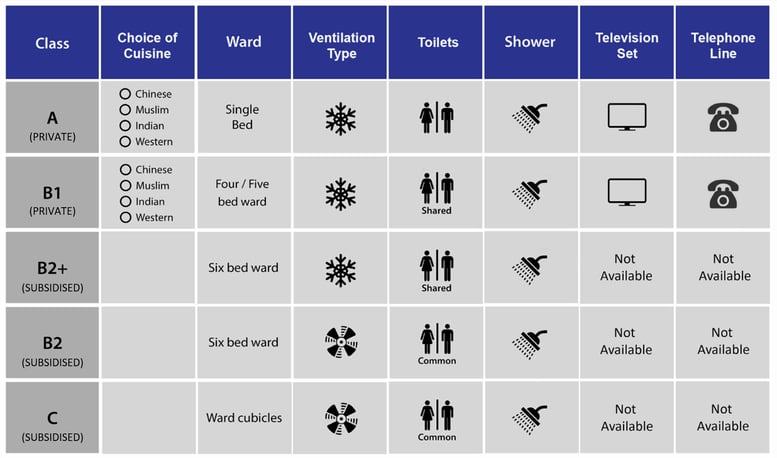
Source: Types of Wards at Ang Mo Kio: Thye Hua Kwan Hospital
MediShield Life is designed around subsidised B2/C wards in public hospitals. If you are willing to stay in those wards, government guides are clear: MediShield Life generally provides sufficient coverage for large hospital bills after subsidies.
Deductibles and co-insurance can be funded from MediSave, subject to withdrawal limits. And in many routine hospitalisation episodes, the incremental payout from an IP can be modest if you are already heavily subsidised.
This creates a rational pathway for FIRE households:
- Commit to B2/C wards.
- Build a medical emergency buffer.
- Accept the trade-off in amenities and waiting time.
- Avoid escalating IP premiums in your 50s and 60s.
Many Singaporeans with IPs still end up choosing subsidised wards. That suggests some are paying for optional private coverage they rarely use.
For a FIRE planner who truly prefers subsidised care, a MediShield-only strategy is not reckless. It is cost-efficient; if deliberate.
The Private Hospital Question
An IP allows you to match coverage to B1/A wards or private hospitals. While MediShield Life still pays something for higher-class wards, the payout is pro-rated. The balance must come from MediSave, cash, or an IP.
The benefits of keeping private-level IP coverage are straightforward:
- Greater choice of doctor
- Shorter waiting times, especially for elective procedures
- Higher claim limits and broader pre/post-hospitalisation benefits
The costs are equally clear:
- Premiums rise steeply with age
- Increasing cash component beyond MediSave limits
- Exposure to co-payment rules and claim-based pricing
- Difficulty upgrading later if health conditions emerge
The FIRE question becomes behavioural, not technical:
When the serious medical event happens, will you actually insist on private care?
If the answer is yes, dropping your IP means you are self-insuring a very expensive preference.
If the honest answer is no, then paying escalating premiums for decades may quietly erode your withdrawal rate.
Premium Creep vs Portfolio Drag
IP premiums have risen across age bands as claims and treatment costs increase. Regulators and advisers have signalled that upward adjustments are likely to continue.
For someone pursuing FIRE at 45 or 50, the math matters. A S$3,000–S$5,000 annual premium in your 50s compounds into a meaningful drag over 20–30 years of early retirement.
Downgrading to a lower ward tier or reverting to MediShield Life does not remove coverage. The base layer remains intact for life, without exclusions for pre-existing conditions.
The real shift is this: you accept more exposure to high private-hospital bills in exchange for lower predictable premiums.
That is a risk trade, not recklessness.
A Structured Risk Comparison

Rather than asking, “Is FIRE without an IP dangerous?”, a more useful framework is:
You may rationally drop or downgrade your IP if:
- You are genuinely comfortable with B2/C wards
- Your portfolio includes a medical emergency buffer
- You prioritise predictable, lower premiums over private choice
You may want to retain an IP if:
- You strongly value private specialists and shorter queues
- You would not hesitate to choose A-ward or private care
- Your FIRE math comfortably absorbs rising premiums
The danger is not in either choice. The danger is in mismatching your insurance structure with your real behaviour.
FIRE Is About Optionality
Financial independence is about designing systems that support your preferences sustainably.
- Keeping an IP is a decision to pre-fund flexibility and private access.
- Dropping an IP is a decision to rely on Singapore’s subsidised system and protect your long-term cash flow.
Neither is automatically correct. Both require clarity.
What turns the decision into recklessness is not the absence of an IP, it is ignoring your true hospital preference and failing to check whether your FIRE plan can withstand the consequences.
When framed properly, this stops being an emotional insurance debate and becomes what it should be: a structured component of your early retirement strategy.
Sources consulted:
- AAMKh – Ang Mo Kio – Thye Hua Kwan Hospital — Ward Types & Charges
- HealthInsured.sg — Understanding Hospital Bills, MediSave, MediShield & Integrated Shield Plans
- The Business Times — Should You Drop Your Integrated Shield Plan? Health Scare Offers Insights
- Central Provident Fund Board (CPFB) — What to Know When Buying an Integrated Shield Plan
- Financial Alliance (engage.fa.com.sg) — Reducing and Downgrading My Integrated Shield Plan Benefits: Reasons and Risks
- Ministry of Health Singapore (MOH) — MediShield Life
- DBS Bank — Health Insurance: Public vs Private Hospitals
Let us know what you think about this topic, and what do you want to hear next.
You can now be our community contributor and make a pitch to have your favourite personality be on our show.
Join our community group and drop us your insights on this topic.





Let us know what you think of this post