
-Jun-01-2025-06-24-42-9139-PM.png?width=50&name=Square%20(2)-Jun-01-2025-06-24-42-9139-PM.png)

DINK (dual income, no kids) households are becoming more visible in Singapore, and some are pairing this lifestyle with the FIRE goal of financial independence and early retirement. In a high-cost, high-pressure city, remaining child-free can free up income and mental bandwidth, allowing couples to build investment portfolios earlier than many of their peers.
That said, DINK is not a shortcut to FIRE. It is better understood as a set of structural advantages that, if combined with discipline and aligned values, can make early financial independence more feasible.
Why DINK is rising in Singapore
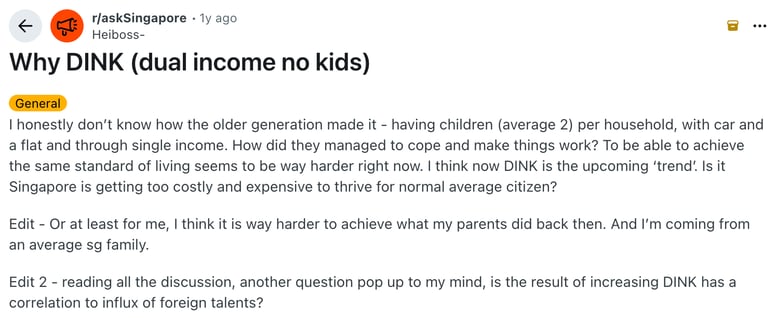
Online discussions offer some insight into why DINK resonates with younger Singaporeans. On r/askSingapore, one widely discussed thread frames the choice as a rational response to today’s economic realities. Housing, childcare, and education costs are perceived to be significantly higher than in previous generations, while wages and job security feel less certain.
Many commenters describe feeling financially “squeezed” even on decent incomes, particularly when projecting the long-term costs of raising children in Singapore. For some, opting out of parenthood is less about rejecting family life and more about preserving financial stability, mental health, and a standard of living they find sustainable.
Others also cite non-financial considerations, such as environmental uncertainty or not wanting to take on irreversible responsibilities without a strong sense of readiness. Taken together, DINK emerges not as a fringe lifestyle, but as one of several adaptive responses to rising costs and uncertainty.
The structural advantages DINKs have for FIRE
From a financial planning perspective, DINK couples start with clear advantages.
With two incomes supporting two adults, fixed costs such as housing, utilities, and groceries do not double. This means a larger proportion of household income can be directed towards savings and investments. Personal finance writers often estimate that DINK households enjoy a 15–20 year “head start” compared to peers who have children, simply because they avoid large, recurring expenses during their highest-earning years.
Illustrative scenarios from local finance sites often use familiar FIRE assumptions. For example, a DINK household targeting S$72,000 in annual spending might aim for a S$1.8 million portfolio using the classic 25× expenses guideline, assuming a high savings rate. Singapore’s relatively low personal income tax further amplifies this advantage, allowing high-earning couples to invest a substantial after-tax surplus.
These assumptions, however, depend heavily on lifestyle choices and consistency over long periods.
What real-life DINK FIRE examples show
Discussions on local FIRE forums such as Reddit provide concrete examples of how this plays out in practice.
One frequently cited case involves a DINK couple in their late 40s and 50s who reached FIRE with roughly S$3 million in assets. They live in a fully paid 4-room HDB flat, do not own a car, and maintain a portfolio centred on global equity index funds, supplemented by CPF balances, SRS investments, and a cash or bond buffer.
Their planned annual spending of S$60,000–S$70,000 implies a withdrawal rate of about 2–2.5%, which is conservative by FIRE standards. In their reflections, the couple emphasised alignment: having two incomes mattered, but having shared views on spending, risk, and lifestyle mattered just as much.

Other discussions explore variations, including non-romantic arrangements where housemates share housing costs while each pursues financial independence independently. These examples highlight that the DINK advantage often comes less from income alone and more from cost-sharing and intentional living.
How DINKs in Singapore tend to pursue FIRE
Across local guides and forum discussions, a broadly similar playbook appears.
Many DINKs aim for high savings rates—often 40–60% of household income, by keeping lifestyle inflation in check and, where possible, living on one income while investing the other. Regular investing into diversified, low-cost global equity funds features prominently, particularly in the early accumulation years.
CPF, Singapore Savings Bonds, and other low-risk instruments are typically used as the stabilising portion of the portfolio, with allocations adjusted as the FIRE target approaches. Housing decisions are also treated as strategic: some couples opt for modest HDB flats rather than stretching for private property, while others reassess investment properties if the complexity and risk no longer justify the returns.
Importantly, commentators frequently caution that DINK status alone does not guarantee progress. Without discipline, higher disposable income can be absorbed by travel, dining, and lifestyle upgrades, leaving little to show in terms of long-term financial security.
The trade-offs behind DINK and FIRE
While the DINK–FIRE combination can look attractive, it comes with real trade-offs. Some critics argue that overly aggressive FIRE strategies risk becoming joyless if present-day quality of life is sacrificed excessively. Others point to social pressures around marriage and children, or concerns about emotional and social support later in life.
In Singapore discussions, DINK plus FIRE is rarely framed as an easy path or a moral ideal. Instead, it is presented as a deliberate choice that exchanges one set of responsibilities for another.
For couples willing to live below their means, invest consistently, and accept the implications of remaining child-free, the combination of dual incomes, low taxes, and disciplined portfolios can make early financial independence achievable. But like all FIRE paths, it requires clarity, alignment, and a willingness to live with the trade-offs involved.
Source consulted:
- Reddit (r/askSingapore) — Why DINK (Dual Income No Kids)?
- Reddit (r/singapore) — Does the DINK life equate to financial freedom?
- Yahoo Finance Singapore — Achieve FIRE & the DINK lifestyle in Singapore
- Reddit (r/singaporefi) — DINK couple $50M (48F) finally FIRED with $3M
- MoneySmart Singapore — Opinion: DINK lifestyle & FIRE
- Reddit (r/askSingapore) — Singles and DINK couples in their 30s: what are…
Let us know what you think about this topic, and what do you want to hear next.
You can now be our community contributor and make a pitch to have your favourite personality be on our show.
Join our community group and drop us your insights on this topic.





Let us know what you think of this post