
-3.png?width=50&name=Square%20(2)-3.png)

Singapore is not dabbling in artificial intelligence. It is institutionalising it.
In his Budget 2026 speech, Prime Minister Lawrence Wong announced the formation of a new National AI Council — and that he will chair it personally. The move elevates AI from sectoral initiative to national priority.
As PM Wong stated:
“We will therefore establish a new National AI Council, which I will chair, to provide strategic direction and drive Singapore’s AI agenda.”
This is not a symbolic tweak. It is a structural shift.
For high-earning professionals, C-suite leaders and founders reading this in January 2026, the question is not whether AI matters. It is how deeply it will reshape competitive positioning, workforce economics and capital allocation over the next five years.
Let’s unpack what this means.

AI as a Strategic Lever, Not a Tech Trend
Budget 2026 dedicates an entire section to AI under the heading “Harness AI as a Strategic Advantage” .
PM Wong framed the stakes clearly:
“Harnessed well, AI will be a strategic advantage for Singapore.”
And:
“Our advantage does not lie in building the largest frontier models. It lies in deploying AI effectively, responsibly, and at speed.”
This distinction is crucial.
Singapore is not attempting to outspend the US or China in frontier model development. Instead, the bet is on:
- Rapid enterprise adoption
- Regulatory coordination and sandboxing
- Sector-specific “AI Missions”
- Talent upskilling at scale
- Trusted deployment
In other words: applied AI at national scale.
For professionals in finance, manufacturing, logistics, legal services, consulting and healthcare — this means competitive differentiation will increasingly depend on how well your organisation integrates AI into core workflows, not whether you have a pilot chatbot.
The Four AI Missions: Where Capital and Talent Will Flow
The Government will launch “national AI Missions” focused on:
- Advanced manufacturing
- Connectivity and logistics
- Finance
- Healthcare
These are not random picks. They correspond directly to Singapore’s highest-value clusters.
Consider the macro context:
- 2025 GDP growth: 5%
- 2026 projected growth: 2% to 4%
- Inflation projected at 1% to 2%
Growth is moderating. External conditions are volatile. AI becomes a productivity lever — not an optional efficiency upgrade.
For senior executives, this suggests:
- Expect co-investment opportunities and regulatory fast lanes in these sectors.
- Expect increased scrutiny of productivity metrics.
- Expect grant schemes and tax incentives to tilt toward AI expenditure (including expansion of qualifying activities under the Enterprise Innovation Scheme) .
Capital will chase AI-enabled productivity. Boards will expect it.

Income Trends: Why AI Is Politically Timed
The AI push is happening against a backdrop of rising incomes but also structural shifts.
According to SingStat’s Key Household Income Trends, 2025:
- Median monthly household market income rose from $11,558 in 2024 to $12,446 in 2025 (up 7.7% nominal; 6.8% real) .
- Over 2020–2025, real median market income grew cumulatively by 17.0% (3.2% per annum) .
- The Gini coefficient based on household market income per household member fell to 0.452 in 2025 — the lowest since 2015 .
On the surface: strong wage growth, falling inequality, broad-based gains.
But note the structural nuance:
- Employment income’s share of household market income declined to 79.6% in 2025 from 81.1% in 2024 .
- Non-employment income (CPF interest, investment returns, rental, annuities) is rising in importance .
This signals two forces:
- An ageing population increasingly reliant on non-employment income.
- Asset-based income becoming more material across deciles.
AI enters this picture at a delicate moment. If poorly managed, it could:
- Accelerate income polarisation in white-collar sectors.
- Compress mid-tier professional roles.
- Concentrate gains in capital and high-skill talent.
PM Wong acknowledged the anxiety directly:
“Workers worry that AI will displace jobs. Societies worry about misinformation, bias, and the ethical use of powerful technologies. These anxieties are real — and we must confront them squarely.”
The National AI Council is therefore not just about competitiveness — it is about governance and social compact preservation.
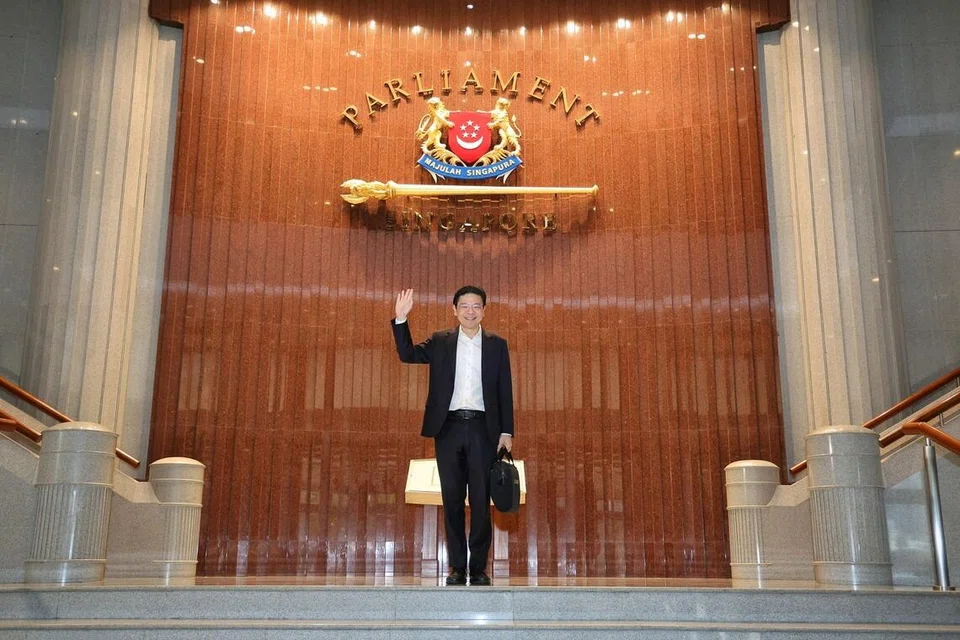
Why PM Wong Chairing the Council Matters
Institutionally, this is significant.
Chaired at Prime Minister level, the National AI Council:
- Cuts across ministries (MDDI, MOE, MOM, MTI) .
- Aligns R&D, regulation, workforce policy and industrial strategy.
- Signals long-term political backing.
For corporate Singapore, that reduces policy uncertainty.
AI regulation will not emerge in fragmented silos. Instead, expect:
- Coordinated sandbox frameworks.
- Faster regulatory iteration.
- Clearer accountability.
For high-income professionals in regulated sectors — especially finance and law — that clarity is economically valuable.
Enterprise Incentives: Follow the Tax Code
Several fiscal levers reinforce the AI push:
- Expansion of qualifying AI expenditure under the Enterprise Innovation Scheme (400% tax deduction, capped at $50,000 per Year of Assessment for 2027 and 2028) .
- Expanded Productivity Solutions Grant for digital and AI-enabled tools .
- Champions of AI programme for firms pursuing comprehensive transformation .
For CFOs and founders, the implication is straightforward:
If you are not structuring AI investments to qualify under these schemes, you are leaving money on the table.
Expect tax planning conversations in 2026 to increasingly incorporate AI capex and software transformation spend.
Career Risk or Career Arbitrage?
At the individual level, the signal is equally clear.
PM Wong stated:
“Our commitment is clear: every Singaporean who is willing to adapt and learn will continue to secure a good job and earn a good living.”
Support includes:
- AI learning pathways via SkillsFuture.
- Six months of free access to premium AI tools for selected trainees .
- Sector-specific capability development starting with accountancy and legal professionals .
For high-earning professionals, this is less about subsidies and more about positioning.
If AI automates:
- Data consolidation
- First-draft document production
- Basic financial modelling
- Routine compliance work
Then value shifts to:
- Judgment
- Advisory
- Strategic synthesis
- Client trust
Those who move up the value chain will command higher premiums. Those who cling to process-heavy roles risk compression.
The arbitrage window is now.

The Macro Overlay: Security, Carbon, and AI
Budget 2026 also signals:
- Defence spending maintained at around 3% of GDP .
- Carbon tax raised to $45 per tonne, with trajectory to $50–$80 by 2030 .
AI intersects both.
Expect:
- AI applications in cybersecurity.
- AI-driven energy optimisation.
- Increased demand for AI-literate professionals in climate finance and risk modelling.
Singapore’s competitive positioning increasingly depends on technological edge across security, sustainability and services.
The National AI Council sits at the centre of this triangulation.
The Bigger Picture: A Small State’s Survival Strategy
PM Wong’s Budget framed a world that is “more contested, more fragmented, and ultimately more dangerous” .
For a small, open economy, AI is not a luxury. It is leverage.
Singapore cannot compete on scale. It competes on coordination, speed and trust.
The formation of a Prime Minister–chaired National AI Council tells us three things:
- AI is now core economic infrastructure.
- Policy integration will accelerate.
- The next decade’s income distribution will be shaped by how well we deploy this technology.
For high earners, the message is not to fear AI.
It is to lead its adoption — before it leads you.
Sources
- Singapore Department of Statistics, Key Household Income Trends, 2025, 9 February 2026
- Ministry of Finance, Budget 2026 Speech: Securing Our Future Together in a Changed World
Let us know what you think about this topic, and what do you want to hear next.
You can now be our community contributor and make a pitch to have your favourite personality be on our show.
Join our community group and drop us your insights on this topic.



Let us know what you think of this post