
-Jun-01-2025-06-24-42-9139-PM.png?width=50&name=Square%20(2)-Jun-01-2025-06-24-42-9139-PM.png)

The Silver Support Scheme is a vital lifeline for many seniors in Singapore, providing quarterly payouts to low-income elderly citizens. However, the scheme operates with strict income thresholds, and exceeding these limits, even by just S$1, can result in complete ineligibility.
This creates what policy experts term a "benefits cliff," where a minimal increase in income leads to a total loss of financial support. Let’s break down what happens if you’re S$1 over the income cap and explore the implications, calculations, and practical considerations.
Understanding the Income Threshold
As of 2025, the Silver Support Scheme sets the qualifying household's monthly income per person at S$2,300 (increased from S$1,800 in 2024).
If your household’s monthly income per person reaches S$2,301 or higher, you become entirely ineligible for Silver Support payments.
This means that a senior who would otherwise qualify for the scheme but whose household income per person is just S$2,301 receives no Silver Support payments. In contrast, someone at S$2,300 could receive up to S$1,080 quarterly (or S$4,320 annually) depending on their flat type.
Here’s how payouts vary based on flat type and income level:
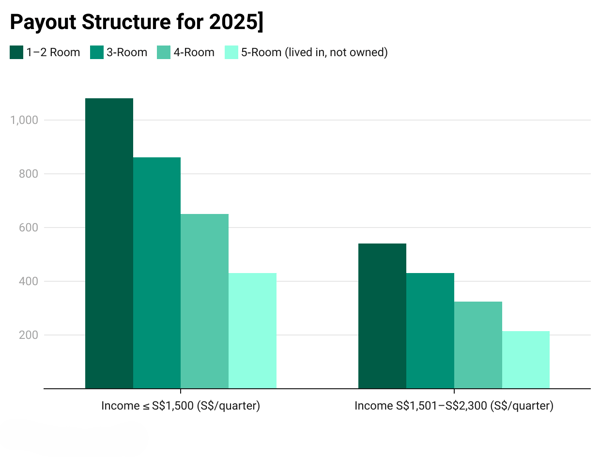
| HDB Flat Type | Income ≤ S$1,500 | Income S$1,501–S$2,300 |
|---|---|---|
| 1–2 Room | S$1,080/quarter | S$540/quarter |
| 3-Room | S$860/quarter | S$430/quarter |
| 4-Room | S$650/quarter | S$325/quarter |
| 5-Room* | S$430/quarter | S$215/quarter |
Note: Applies to living in, but not owning, a 5-room flat.
How Household Income Per Person is Calculated
The scheme uses a precise formula to determine eligibility. Here’s what’s included and excluded in the calculation:
Who Counts as a Household Member?
A household member includes all family members related by blood, marriage, or legal adoption, such as spouses, parents, children, grandparents, grandchildren, siblings, uncles, aunts, cousins, and in-laws. However, only those living at the same residential address are counted.
What Income Sources Are Included?
Income sources included in the household assessment consist of the average monthly employment income over the last available 12-month period.
This encompasses bonuses, as well as net employment income and annual trade income for self-employed individuals. This income should be declared to the CPF Board or assumed under CPF legislation.
What’s Not Included?
On the other hand, certain individuals are not included in the household count. This excludes domestic helpers, unrelated landlords or tenants, and friends living at the same address, as well as family members who do not reside at the specified address.
The Impact of the Benefits Cliff
Exceeding the income threshold by even S$1 results in a complete loss of benefits. For example:
- A senior living in a 1–2 room flat who qualifies for S$1,080 quarterly (S$4,320 annually) loses all payouts if their household income per person rises to S$2,301.
- There’s no pro-rated or graduated reduction in benefits as it’s an all-or-nothing system.
Research by The Majurity Trust highlights how this "benefits cliff" can trap families in poverty. It creates disincentives to increase income, as earning even slightly more can lead to a significant financial loss.
This situation disproportionately affects seniors near the income cap, making careful income management critical.
Complete Eligibility Requirements
Beyond the income threshold, seniors must meet several other criteria to qualify for Silver Support:
Here’s the information in a table format:
| Criteria | Details |
|---|---|
| Citizenship | Must be a Singapore citizen aged 65 and above. |
| CPF Contributions | Total CPF contributions by age 55 must not exceed S$140,000. |
| Household Income | Monthly income per person must not exceed S$2,300. |
| Housing | Must live in a 1–5 room HDB flat. |
| Property Ownership | Neither you nor your spouse should own a 5-room+ HDB flat, private property, or multiple properties. |
| Self-Employed Criterion | Average annual net trade income between ages 45–54 must not exceed S$27,600. |
No Appeal or Flexibility Mechanism
Unlike some other government schemes, the Silver Support Scheme operates with strict adherence to its thresholds.
It does not allow for appeals based on special circumstances, graduated reductions in benefits for slight threshold exceedances, or temporary exemptions for income fluctuations.
This rigidity ensures targeted assistance for those deemed most in need but leaves no room for flexibility for those just above the cap.
Practical Implications for Seniors
For seniors and their families close to the S$2,300 threshold, this creates several challenges:
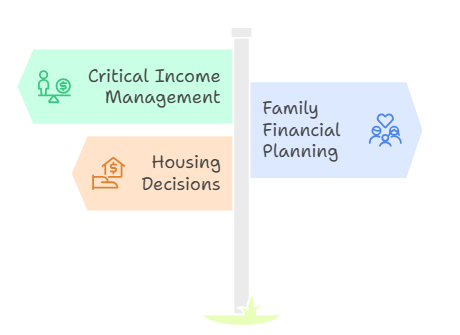
Critical Income Management
Earning just S$1 more per person in the household eliminates S$4,320 in annual support. Families must carefully manage their income to avoid crossing the threshold.

Family Financial Planning
Decisions about employment, living arrangements, or housing must consider the "cliff effect." For example:
- A part-time job that slightly increases household income could disqualify a senior from Silver Support.
- Maintaining separate households might help keep individual incomes below the cap.
Housing Decisions
Seniors may choose to remain in smaller flats (e.g., 1–2 room flats) to stay eligible for higher payouts. Upgrading to larger flats could push them over the income or property ownership thresholds.
Government’s Approach to Benefits Cliffs
The government acknowledges the issue of benefit cliffs and has implemented measures to mitigate it across the broader social assistance ecosystem.
Different schemes use varying income thresholds to prevent families from simultaneously losing all forms of support.
The strict income cap remains a defining feature of the scheme, ensuring substantial support for those most in need while maintaining clear boundaries for eligibility.

Bite-Sized Pro-Tips for Steering the Silver Support Scheme
- Know Your Thresholds: Understand the income cap and ensure your household income per person stays below S$2,300.
- Plan Employment Carefully: Avoid taking on work that pushes your household income over the limit.
- Consider Housing Choices: Staying in smaller HDB flats can help maintain eligibility for higher payouts.
- Track Changes Annually: Review your household income and eligibility status regularly to avoid surprises.
- Seek Professional Advice: Consult financial planners or social service agencies for guidance tailored to your situation.
Bottom Line: Balancing Targeted Support and Fairness
The Silver Support Scheme exemplifies Singapore’s targeted approach to social assistance. While it provides substantial support to those deemed most in need, its strict income thresholds can create significant financial cliffs for those who exceed them by minimal amounts.
For seniors and their families, understanding the rules and planning accordingly is crucial. By managing income, housing, and employment decisions, you can maximize your eligibility for this vital support.
However, policymakers may need to consider ways to soften the impact of the benefits cliff, ensuring that incremental income increases don’t result in disproportionate financial losses.
If you’re nearing the income cap, take proactive steps now to navigate this challenge effectively. After all, every dollar counts when it comes to securing financial stability in your golden years.
References:
- Majurity, "The Benefits Cliff in Singapore"
- If Only Singaporeans, "Tackling Poverty the Kuih Lapis Way"
- Together for Better, "Seniors"
- Today Online, "Budget
- 2024 cheat sheet: What you need to know"
- Ministry of Manpower, "Silver Support Scheme"
- CPF Official Website, "Do I qualify for the Silver Support Scheme?"
- SupportGoWhere, "Silver Support Scheme"
Let us know what you think about this topic, and what do you want to hear next.
You can now be our community contributor and make a pitch to have your favourite personality be on our show.
Join our community group and drop us your insights on this topic.




Let us know what you think of this post