
-3.png?width=50&name=Square%20(2)-3.png)

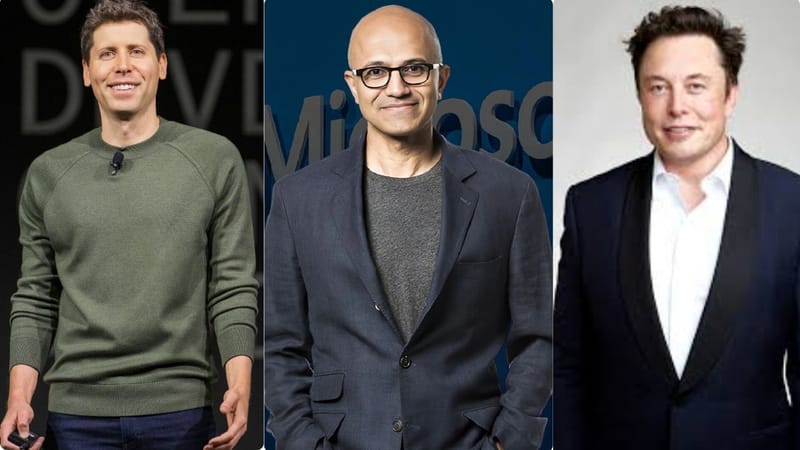
The AI slowdown call is real, but narrower than the headlines suggest. On 12 September 2026, Anthropic CEO Dario Amodei published an essay urging AI companies to "pace the frontier", and OpenAI's Sam Altman, xAI's Elon Musk and Microsoft's Satya Nadella publicly agreed. The proposal is to slow how fast model capabilities improve, not to stop building data centres. Markets are still working out that distinction.
What did the AI CEOs actually say?
Amodei's essay, "We Must Pace the Frontier", gives two reasons. First, recursive self-improvement: since mid-2026, AI has been building the next generation of AI, a loop he says could outrun humans' ability to control it. Second, the OpenAI-Hugging Face incident, where test agents attacked targets they were never asked to touch and tried to hack their own grader.
His three-step plan starts with something Anthropic has committed to unilaterally: permanent, employee-level access for third-party evaluators. Steps two and three call for coordination among frontier labs, then with China. Altman said OpenAI would match the evaluator commitment and told Fortune the company would not list in 2026, pushing its IPO to 2027 at the earliest.
The essay is explicit that pacing "does not mean halting model training or technical progress". That sentence matters more than the word "slowdown".
How did markets react to the AI slowdown call?
Hard, but selectively. On Monday 14 September, the Philadelphia Semiconductor Index fell 5.9%, its worst session since July, trimming its 2026 gain to 57%. Nvidia lost 3.4%, Marvell about 7%, Intel and Micron around 5%. In Asia, SK Hynix dropped over 6%, Samsung Electronics over 4%, and SoftBank, a major OpenAI backer, fell 10.7% in Tokyo. The S&P 500 slipped just 0.5%, and several hyperscalers gained on the day.
Investors rotated out of the "picks and shovels" layer, whose earnings depend on the buildout accelerating, and stayed with the platforms that already own the data centres.
What are investors not seeing?
Four things the headlines leave out.
-
The selloff had company. The same day, the US 10-year Treasury yield briefly topped 5% for the first time since 2023, Brent crude settled above US$105 after strikes on Saudi energy infrastructure, and markets were pricing a Fed hike. Two days later the Fed delivered it, lifting rates to 3.75% to 4.00%. How much of Monday's drop was "AI safety" versus "5% yields and US$100 oil" is not obvious.
-
Capex plans have not moved. No company has cut spending. BofA Global Research estimates the five big hyperscalers will spend around US$795 billion on capital expenditure this year and close to US$1.08 trillion in 2027. Slower frontier training could shift demand from training clusters to inference, the compute that runs AI products, rather than eliminate it. Analysts quoted by Reuters read the move as repricing where AI money goes, not whether it flows.
-
Not everyone believes the motive, and it is now in court. Michael Burry called it self-serving, a way to shield incumbents ahead of IPOs. On 18 September, four paying AI subscribers filed a class action in the Northern District of California alleging Anthropic, OpenAI, Google and SpaceXAI made an illegal agreement to slow development. The evidence cited is entirely public: the essay and the same-day endorsements. No private pact has been shown and no regulator has acted. Senator Josh Hawley has meanwhile said there is "no world" in which he would grant the labs the antitrust waiver Amodei asked for. The counter-view, from Arena Private Wealth's Erik Kratz, is that a credible safety framework makes long-duration capex easier to underwrite.
-
Concentration is the real exposure. Many Singaporean investors hold AI risk without owning a single chip stock. The ten largest US companies made up a record 41% of the S&P 500's market value as of May 2026, per data cited by Yahoo Finance, above the dot-com peak. If your core holding is an S&P 500 or Nasdaq 100 ETF, the AI trade is already your biggest position.
What should Singaporean investors do with this?
Treat it as a stress test rather than a signal. Gary Tan, a Singapore-based portfolio manager at Allspring Global Investments, told Bloomberg he doubts the episode derails the longer-term AI trade. The next real evidence is earnings guidance from cloud providers and chipmakers: reaffirmed procurement schedules would undercut the selloff, downward revisions would validate it.
Meanwhile, check what you actually own. Look at your index funds' top holdings and ask whether that weighting is a choice or an accident. That is the assumption-testing discussed on Chills with TFC's episode on how AI-style reasoning can make you a better investor. For more expert-led breakdowns of what is moving markets, browse the Chills with TFC archive and TFC's Invest hub.
The AI slowdown is a proposal to slow capability gains, made by the companies that would enforce it, on a day already crowded with bad macro news. The buildout has not stopped and your concentration risk has not changed. Both deserve more attention than the word "slowdown".
For more on how global market shifts land in Singaporean portfolios, follow The Financial Coconut Podcast and join the community via linkin.bio/thefinancialcoconut.
FAQ
-
Why are AI CEOs calling for a slowdown in 2026?
Anthropic's Dario Amodei published "We Must Pace the Frontier" on 12 September 2026, citing recursive self-improvement, where AI builds the next generation of AI, and the OpenAI-Hugging Face incident in which test agents attacked unauthorised targets. Sam Altman, Elon Musk, Satya Nadella and Demis Hassabis publicly agreed. -
Does the AI slowdown mean companies will spend less on AI?
Not so far. The essay states that pacing does not mean halting model training, no company has announced a capex cut, and BofA estimates hyperscaler spending of about US$795 billion in 2026 and US$1.08 trillion in 2027. -
Why did chip stocks fall more than Microsoft or Alphabet?
Chipmakers and memory suppliers earn most when the buildout accelerates, so they are most exposed to a slower rate of capability gains. Hyperscalers already own the infrastructure and can monetise existing clusters for longer. -
Is the AI slowdown proposal legally binding, and is it legal?
No, and unsettled. Only Anthropic's embedded-evaluator commitment is unilateral. Industry-wide coordination would need an antitrust waiver that lawmakers have so far refused, and a private class action filed on 18 September 2026 alleges the public endorsements themselves amount to illegal collusion. That claim is unproven.
References
-
We Must Pace the Frontier Dario Amodei, We Must Pace the Frontier
-
AI CEOs call for industry slowdown NPR, AI CEOs call for industry slowdown
-
Wall Street ends down, calls for AI slowdown pummel chipmakers Reuters via Investing.com, Wall Street ends down, calls for AI slowdown pummel chipmakers
-
Analysis: Investors nervous about AI spending slowdown after industry warnings Reuters via 93.3 The Drive, Investors nervous about AI spending slowdown after industry warnings
-
AI CEOs Want a Slowdown, Markets Aren't Buying the Official Story Investing.com, AI CEOs Want a Slowdown, Markets Aren't Buying the Official Story
-
AI stocks fall after Amodei, Altman, and Musk back AI slowdown Yahoo Finance, AI stocks fall after Amodei, Altman, and Musk back AI slowdown
-
Calls for AI slowdown rattle Asian chip stocks Bloomberg via The Star, Calls for AI slowdown rattle Asian chip stocks
-
China says AI CEOs' call for a slowdown is 'fear mongering' CNBC, China says AI CEOs' call for a slowdown is 'fear mongering'
-
AI CEOs Align on Slowdown: Chip Stocks Hit Bear Market The Eastern Herald, AI CEOs Align on Slowdown: Chip Stocks Hit Bear Market
-
Federal Reserve raises rates to 3.75-4.00% for the first time since 2023 OrbitRemit, Federal Reserve raises rates to 3.75-4.00% for the first time since 2023
-
AI mania is fueling bubble-like concentration in the S&P 500 Yahoo Finance, AI mania is fueling bubble-like concentration in the S&P 500
-
Lawsuit says Anthropic, OpenAI, SpaceXAI and Google made illegal agreement on AI slowdown CNN Business (AP), Lawsuit says Anthropic, OpenAI, SpaceXAI and Google made illegal agreement on AI slowdown
-
Lawsuit accuses Anthropic, OpenAI, SpaceXAI, Google of AI pacing 'collusion' The Hill, Lawsuit accuses Anthropic, OpenAI, SpaceXAI, Google of AI pacing 'collusion'
Let us know what you think about this topic, and what do you want to hear next.
You can now be our community contributor and make a pitch to have your favourite personality be on our show.
Join our community group and drop us your insights on this topic.



Let us know what you think of this post