
-4.png?width=50&name=Square%20(2)-4.png)

How a seemingly clever property hack became a criminal offence... and what Singaporean homebuyers need to know in 2025
It started as whispered advice between property agents and eager homebuyers. A "strategy" to sidestep Singapore's punishing Additional Buyer's Stamp Duty (ABSD) rates. Own 99 per cent of a property, sell 1 per cent to your spouse or partner, and suddenly you're saving hundreds of thousands of dollars in taxes. Simple, right?
Not quite. By February 2025, a mother and son became the first Singaporeans to be jailed for what authorities call the "two-step 99-to-1" scheme. They each received two weeks' imprisonment—and that was just the beginning of their troubles.
As we close out 2025, the landscape of property ownership in Singapore has fundamentally shifted. What many believed was a legitimate tax-planning tool has been exposed as a minefield of legal risks, aggressive enforcement, and costly consequences. If you've considered the 99-1 arrangement, or worse, already executed one, this is everything you need to know.
The Brutal Maths Behind Singapore's ABSD: Why People Tried the 99-1 Scheme
To understand why the 99-1 scheme became so tempting, you need to grasp just how expensive ABSD has become for Singaporeans with property ambitions.
Since 27 April 2023, Singapore citizens face the following ABSD rates:
- First property: 0% (no ABSD)
- Second property: 20%
- Third and subsequent properties: 30%
For permanent residents, the rates are even steeper: 5% on the first property, 30% on the second, and 35% on subsequent purchases. Foreigners pay a flat 60% regardless.
Let's put this in concrete terms. Suppose you're a Singaporean couple eyeing a second property worth S$1.5 million. If you already own one property and are listed as a buyer, you'll owe:
S$1,500,000 × 20% = S$300,000 in ABSD
That's S$300,000 on top of your down payment, Buyer's Stamp Duty, legal fees, and everything else. It's a colossal sum—enough to buy a modest resale HDB flat outright in some estates.
Now imagine someone tells you there's a way to reduce that S$300,000 to just S$2,000. That's what the 99-1 scheme promised.
What Exactly Is the Two-Step 99-to-1 Scheme?
The two-step 99-to-1 arrangement works like this:
Step 1: A buyer with no existing property (let's call her Ms A) purchases a private residential property worth S$1.5 million entirely in her name. She pays 0% ABSD because it's her first property.
Step 2: Within days - sometimes within hours - Ms A sells a 1% share of the property to Mr B, her spouse or partner who already owns another property and would otherwise face 20% ABSD.
Mr B now pays ABSD on only his 1% share: S$15,000 (1% of S$1.5 million) × 20% = S$3,000
Instead of S$300,000, the couple pays S$3,000 in ABSD. They've just "saved" S$297,000.
This arrangement allows Mr B to co-apply for the housing loan based on his income, giving the couple significantly more borrowing power. In other words, Ms A couldn't have afforded the property without Mr B's financial involvement, but by structuring it this way, they avoided the ABSD that should have applied if they'd bought jointly from the start.

The Misleading Name: Why Experts Call It "100-Sell-1," Not "99-to-1"
Here's where terminology matters—and where confusion has caused genuine misunderstanding amongst Singapore property buyers.
The phrase "99-to-1" that dominates media headlines is technically misleading, according to industry experts. Eugene Lim, Key Executive Officer at ERA Singapore, argues that "perhaps it's more accurate to describe such two-step purchases as '100-sell-1,' as opposed to the '99-to-1' phrase often used by the media to refer to schemes that exploit the ABSD loophole."
Why does this distinction matter?
The term "100-sell-1" accurately describes the illegal scheme:
- Party A buys 100% of the property initially (as a first-time buyer with 0% ABSD)
- Party A then sells 1% to Party B (an existing property owner) within days
- Party B only pays ABSD on that 1% share
The term "99-to-1," by contrast, simply describes a legitimate ownership ratio under tenancy-in-common. Using "99-to-1" as shorthand for the illegal scheme "conveys the wrong impression that all 99-to-1 holding arrangements are illegitimate," warns Lim.

Can You Own Property in Other Ratios? What About 95-5 or 90-10?
Absolutely. Nicholas Poa, Senior Vice President of Legal and Compliance at ERA Singapore, emphasises: "Co-owning a property in any proportion – even in a 99-to-1 structure – under tenancy-in-common isn't illegal."
Singaporean couples and co-owners can legally hold property in ratios such as:
- 50-50 (equal ownership)
- 70-30 (reflecting different financial contributions)
- 80-20 (where one spouse contributes more)
- 90-10, 95-5, or 99-1 (for loan eligibility or decoupling plans)
The ratio itself isn't the problem. What matters is:
- When the ratio is established (from the outset vs. added later via subsale)
- Why the structure is chosen (legitimate reasons vs. purely ABSD avoidance)
- Whether both parties have existing properties at the point of purchase
Three Legitimate Reasons for Unequal Ownership Splits
According to ERA's Nicholas Poa, there are three commercially valid reasons for holding property in unequal ratios:
1. Fairness Based on Financial Contribution If Party A contributes S$900,000 and Party B contributes S$100,000 toward a S$1 million property, a 90-10 ownership split accurately reflects their investments. This is standard practice for investment properties or when unmarried couples buy together.
2. Maximising Loan Eligibility If Party A's income alone qualifies them for a S$1 million loan, but they want to buy a S$1.5 million property, adding Party B as a co-owner (even with just 1% ownership) allows the bank to assess both incomes. This can unlock an additional S$500,000 in borrowing capacity whilst reducing the cash downpayment required.
Crucially, this is legal if both parties genuinely co-own from the beginning. It becomes illegal when structured as 100-sell-1 with an existing property owner added after the fact.
3. Future Decoupling Plans Married couples buying their first property may intentionally choose a 99-1 split to facilitate easier decoupling later. When the time comes to buy a second property, the 1% owner can transfer their stake to the 99% owner, effectively becoming a "non-owner" eligible for better ABSD treatment on the next purchase.
Poa clarifies: "Even though decoupling makes use of the 99-to-1 shareholding structure, it's also quite different from the '100-sell-1' scheme. For decoupling, both co-buyers don't own any other property when purchasing their first home in a shareholding structure. In other words, they won't have any ABSD obligations in the first place."
The Critical Timing Difference
Here's the line between legal and illegal:
| Legal 99-1 Ownership | Illegal 100-Sell-1 Scheme |
|---|---|
| Both parties are first-time buyers OR both transparently declare ABSD status | One party already owns property and is trying to avoid ABSD |
| Ownership ratio established from day one of purchase | Ownership changed within days/weeks after initial purchase via subsale |
| Ownership split reflects genuine agreement, contributions, or planning | Ownership split designed purely to manipulate ABSD calculations |
| ABSD (if any) paid correctly at point of initial purchase | ABSD deliberately underpaid through artificial structuring |
The government isn't banning unequal ownership ratios. What IRAS is aggressively targeting is the artificial splitting of a single transaction into multiple steps to game the ABSD system.

Why the 99-1 Scheme Is Illegal: IRAS's Definition of Tax Avoidance
Here's where things get serious. The Inland Revenue Authority of Singapore (IRAS) doesn't mess about when it comes to tax avoidance. On May 7th, 2024, Deputy Prime Minister and Minister for Finance Lawrence Wong made this crystal clear when he told Parliament:
"The '99-to-1' arrangement is a tax avoidance arrangement used by some property buyers to reduce the rightful ABSD payable on the purchase of a residential property."
IRAS has legal powers under Section 33A of the Stamp Duties Act to disregard artificial transactions. When a single property purchase is deliberately split into multiple steps to reduce tax, the Commissioner of Stamp Duties can:
- Disregard the individual steps and assess stamp duty as if it were a single joint purchase from the beginning
- Recover the full ABSD that should have been paid
- Impose a 50% surcharge on top of the unpaid ABSD
- Prosecute for providing false information if buyers lie during audits
According to IRAS's official statements, whether a 99-to-1 arrangement involves tax avoidance "depends on the facts and circumstances surrounding the specific case." The key question is: was the structure contrived and artificial, designed purely to obtain a tax advantage not intended by Parliament?
If the answer is yes, you're in trouble.

The Enforcement Wave: S$60 Million Clawed Back and Criminal Prosecutions
IRAS isn't just making threats. The numbers are staggering.
As of May 2024, IRAS completed reviews of 187 cases involving 99-to-1 arrangements. Of those, 166 cases were found to involve tax avoidance. The total amount being clawed back? S$60 million in ABSD and surcharges.
But financial penalties aren't the only consequence. In February 2025, 56-year-old Ng Chiew Yen and her 26-year-old son Keith Tan became the first Singaporeans to face criminal prosecution for a 99-to-1 scheme.
The Case of Ng and Tan: What Went Wrong
On 24 September 2021, Keith Tan purchased a condominium unit at 49 Canberra Drive for S$1,113,000 in his name alone. Three days later, he sold a 1% share to his mother, Ng Chiew Yen, for S$11,130. Because Ng already owned another property, she paid ABSD only on the 1% share.
The reality? Tan was unemployed at the time and couldn't qualify for a housing loan. The plan all along was to add his mother as a joint owner so they could secure financing but by structuring it as a two-step transaction, they attempted to avoid S$130,779 in ABSD.
When IRAS audited them in 2023, the pair conspired to provide false information. Tan claimed he'd made a "hasty decision" to buy the property with family support, and that financial difficulties later forced him to add his mother. They even deleted 109 WhatsApp messages that contradicted their story before submitting "curated" messages to IRAS.
District Judge Chay Yuen Fatt wasn't buying it. Both were convicted under Section 65(2) of the Stamp Duties Act 1929 for providing false and misleading information. Each received two weeks' imprisonment. They still owed the S$130,779 ABSD plus a 50% surcharge of S$65,389—a total of S$196,168 on top of their jail time.
According to IRAS's press release: "This is the first conviction involving taxpayers providing false and misleading information to IRAS during an audit of the two-step '99-to-1' property transactions."
The message? IRAS is serious, and cooperation is not optional.

The Lawsuits: Buyers Blaming Property Agents and Lawyers
It gets messier. As IRAS audits intensified, property buyers caught in 99-to-1 schemes began suing the very professionals who advised them.
By late 2025, at least three lawsuits had been filed against PropNex, its agents, and law firms involved in facilitating these transactions. One case involved a couple, Neo Say Chuan and Tiong Bock Lian, who sued PropNex Realty, salesperson Don Tay, and Anthony Law Corporation for S$586,172, the exact amount IRAS demanded in additional tax and surcharges.
Another buyer, speaking anonymously to The Business Times, described being "advised by the agent, with the assistance of the banker and lawyer, to go with this arrangement" to secure sufficient financing. Now facing hundreds of thousands in ABSD payments, buyers claim they were never warned of the legal risks.
Law firm City Law, named in one lawsuit, denied advising clients that 99-to-1 arrangements were legal. In its defence, the firm stated: "The scope of its work did not include advising on the legality or potential implications of the '99-to-1' arrangement."
The Council for Estate Agencies (CEA) is investigating approximately 10 cases involving property agents. Depending on findings, agents could face financial penalties up to S$100,000, suspension, or revocation of their licences.

Legitimate Decoupling vs the 99-1 Scheme: What's the Difference?
This is where nuance matters. Not all 99-1 ownership structures are illegal. In fact, tenancy-in-common arrangements with unequal shares are perfectly legal - if done for legitimate reasons.
What Is Legitimate Decoupling?
Decoupling is a legal restructuring strategy where one co-owner transfers their full share of a property to another co-owner. This is typically done by married couples who jointly own their first property and want to buy a second property without incurring ABSD.
Here's how it works:
- A couple owns their first property 50-50 (or 99-1)
- Spouse A transfers their entire share to Spouse B, paying Buyer's Stamp Duty (BSD) on that transfer
- Spouse A now has zero property count and can buy a second property without ABSD
- Spouse B remains the sole owner of the first property
This is legal as long as it's a genuine, permanent transfer with no secret arrangement for Spouse A to retain beneficial ownership.
The High Court's 2025 Ruling: When Decoupling Crosses the Line
In August 2025, Justice Lee Seiu Kin issued a landmark ruling that clarified when decoupling becomes illegal. The case involved an unmarried couple who held their property 99-to-1, with plans to decouple later so the 1% owner could buy a second property without ABSD.
Justice Lee found that "while buyers were free to hold their stakes in a 99-to-1 arrangement, the transaction could be illegal if the decoupling was undertaken to avoid paying more tax." Specifically, if the 1% owner gives up their legal share but secretly retains beneficial ownership (e.g., through an undisclosed agreement to continue enjoying the property), three criminal issues arise:
- Tax evasion by wrongful declaration of ownership
- ABSD evasion on the second property purchase
- Understamping because stamp duty was only paid on 1% instead of the true 50% ownership
The judge noted: "If this scheme is exposed, such as in a dispute, the consequences could be severe."
So What's the Key Difference?
| Legitimate Decoupling | Illegal 99-1 Scheme |
|---|---|
| Genuine, permanent transfer of ownership | Two-step transaction designed to split a single purchase |
| Transferring spouse truly relinquishes all ownership | Both parties always intended joint ownership and loan application |
| Done after holding property for some time | Done within days or hours of initial purchase |
| Motivated by life changes (e.g., second property plans, estate planning) | Solely motivated by ABSD avoidance |
| Transparent to IRAS | Often involves false declarations during audits |
As Stacked Homes summarised: "Whether a 99-to-1 arrangement involves tax avoidance depends on the facts and circumstances surrounding the specific case... authorities can treat any contrived use of that structure as tax avoidance."
The Millie Wong Case: A Cautionary Tale from the Courts
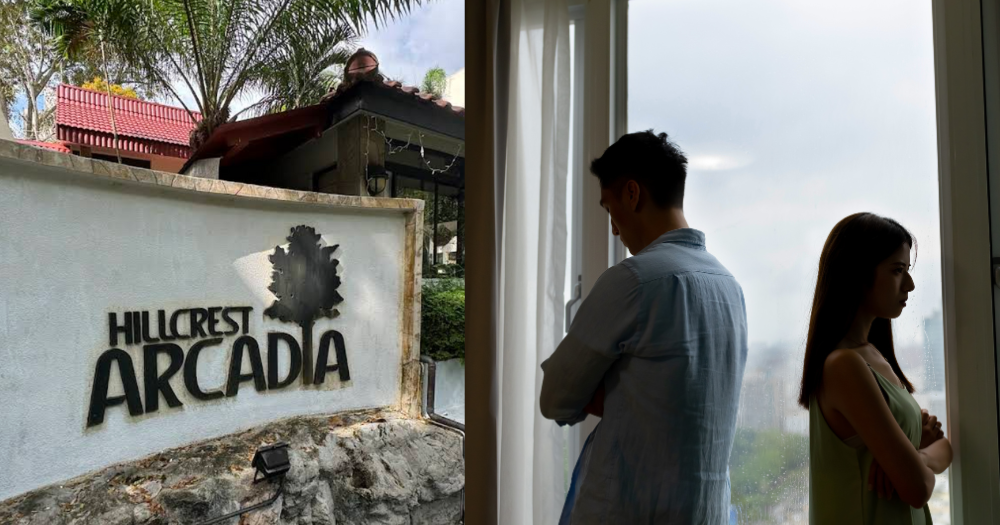
Perhaps no case illustrates the risks of 99-1 arrangements better than the 2025 High Court dispute between Millie Wong, 38, and Jake Ngor, 35.
In March 2020, the couple bought a S$1.865 million condominium at Hillcrest Arcadia, registering ownership 99% to Wong and 1% to Ngor. Wong insisted on this split due to fears that Ngor might be unfaithful—owning 99% would give her security if he cheated.
They broke up in November 2020. When Ngor suggested selling the property in 2022, Wong suddenly claimed she owned the full 99% legally and beneficially. Ngor disagreed, arguing he'd funded most of the purchase and deserved a proportional share.
The court examined their WhatsApp conversations. In one exchange, Wong told Ngor: "U better sign a clause that says if u cheat u will be a bankrupt... Ur hse ur kids ur cash... All mine." Later, she said she'd only take his assets if he cheated, and that the arrangement was meant to make him "think 3-4 times" before being unfaithful.
Justice Lee sided with Ngor, ruling he owned a 54.22% beneficial interest based on his financial contributions. The judge rejected Wong's "strained interpretation" that Ngor had gifted her the property unconditionally.
But here's the critical part: the couple admitted they'd planned to use 99-1 ownership to facilitate decoupling later, allowing Ngor to buy a second property without ABSD. Justice Lee noted: "There was no nefarious intention or knowledge that this would be an unlawful act." However, he emphasised that the plan, had it been executed, would have been illegal.
The judge distinguished this case from the two-step 99-to-1 scheme IRAS is targeting, noting it wasn't a staggered transaction designed to evade stamp duty on a single purchase. Still, the judgment made clear: 99-1 ownership with intent to decouple for ABSD avoidance is legally precarious.
What Should You Do If You've Already Entered a 99-1 Arrangement?
If you've executed a two-step 99-to-1 transaction, here's the uncomfortable truth: IRAS can audit you at any time. There's no statutory time limit for stamp duty audits.
IRAS Encourages Voluntary Disclosure
According to IRAS: "Purchasers who entered into two-step 99-to-1 property purchase arrangements should voluntarily disclose their arrangements to IRAS. Depending on the circumstances, IRAS is prepared to consider such cases more favourably."
What does "more favourably" mean? While IRAS will still collect the rightful ABSD and the 50% surcharge, voluntary disclosure may reduce the risk of criminal prosecution for providing false information, which carries penalties of up to S$10,000 in fines or two years' imprisonment.
What If You're Audited?
If IRAS contacts you:
- Do not lie or delete evidence. Ng and Tan's fate shows what happens when you obstruct audits.
- Cooperate fully and promptly. Provide all requested documents and communications.
- Engage a qualified tax lawyer immediately. Do not try to navigate this alone.
- Be prepared to pay. IRAS will recover the full ABSD plus a 50% surcharge. Budget for this.
One anonymous buyer told The Straits Times: "I think it is prudent for lawyers to study the latest court case carefully when advising clients on transfers of properties between co-owners, especially if it is being done with the view of buying another residential property."
IRAS Is Offering Cash Rewards to Whistleblowers
Here's a chilling detail: IRAS is incentivising informants to report 99-1 schemes.
The authority offers a reward of 15% of the tax recovered, capped at S$100,000, to anyone whose information leads to recovery of tax that would otherwise be lost. All payments are discretionary, and informants' identities are kept strictly confidential.
In practical terms, if your property agent, lawyer, banker, or even a disgruntled ex-spouse tips off IRAS about your 99-1 arrangement, and IRAS recovers S$300,000 in taxes, the informant could receive S$45,000.
The threat of whistleblowing adds another layer of risk to these arrangements—even if everyone involved initially agreed to stay silent.

Is Any ABSD "Hack" Worth the Risk?
As we move through December 2025, the message from IRAS, the courts, and the Government is unambiguous: tax avoidance schemes will be pursued aggressively, and the consequences extend far beyond financial penalties.
Ng and Tan learned this the hard way. They paid nearly S$200,000 in ABSD and surcharges, served jail time, and now carry criminal records. Others caught in 99-1 audits are suing their advisors, facing six-figure bills, and enduring years of legal stress.
Was saving S$297,000 worth it? Not when the true cost includes:
- Up to S$300,000+ in clawed-back ABSD and surcharges
- Potential imprisonment for up to two years
- Criminal record
- Legal fees for audits, appeals, and lawsuits
- Damaged relationships and professional reputations
For those considering property strategies in 2025 and beyond:
If you want to legally reduce ABSD, explore legitimate options:
- Buy your first property under one spouse's name (if one spouse's income is sufficient)
- True decoupling with permanent transfers and genuine relinquishment of ownership
- Timing your property sales to avoid simultaneous ownership
- Exploring Executive Condominiums (ECs) or commercial properties with different ABSD rules
But if someone—whether a property agent, lawyer, or banker—suggests a "clever way" to structure ownership that feels too good to be true, walk away. The days of treating ABSD as a negotiable tax are over.
As Associate Professor Stephen Phua of NUS Law told The Straits Times: "The case should serve as a cautionary tale for property buyers to act in good faith and avoid having secret arrangements to hide their true ownership interests."
The 99-1 scheme isn't a loophole. It's a trap. And in 2025, IRAS is watching.
Let us know what you think about this topic, and what do you want to hear next.
You can now be our community contributor and make a pitch to have your favourite personality be on our show.
Join our community group and drop us your insights on this topic.
References
- Channel NewsAsia, "Mother and son jailed in first prosecution of '99-to-1' property purchase scheme"
- Channel NewsAsia, "Mother and son charged with lying to IRAS over 99-to-1 property purchase arrangement"
- Channel NewsAsia, "IRAS to claw back S$60 million from private property buyers who used '99-to-1' scheme to reduce ABSD"
- IRAS, "Mother and son first to be convicted of giving false and misleading information to IRAS during stamp duty audit"
- IRAS, "Mother and Son to be Charged for Giving False and Misleading Information to IRAS during Stamp Duty Audit"
- IRAS, "Additional Buyer's Stamp Duty (ABSD)"
- The Straits Times, "Singapore High Court rules that property 'decoupling' is illegal if done solely to avoid taxes"
- The Business Times, "Couple caught in 99-1 property transaction sue salesperson, PropNex and law firm for S$586,172"
- The Business Times, "Some home buyers facing '99-to-1' ABSD probes, blaming it on advice from real estate agents"
- The Business Times, "City Law denies having advised claimant in 99-1 lawsuit"
- Stacked Homes, "So Is The 99-1 Property Split Strategy Legal Or Not?"
- Mothership, "S'pore woman, 38, claims to own 99% of S$1.8 million Bukit Timah condo bought with ex-boyfriend, 35, judge rejects claim"
- ERA Singapore, "99-to-1 Shareholding: Legit Arrangement or Illegal ABSD Loophole? Issues Explained!"






-2.png?height=200&name=2024%20website%20assets%20(1)-2.png)
Let us know what you think of this post