
-Jun-01-2025-06-24-42-9139-PM.png?width=50&name=Square%20(2)-Jun-01-2025-06-24-42-9139-PM.png)

For most people, retirement means stopping work.
For Singapore business owners, semi-retirement in Thailand usually means something else entirely. You are not walking away. You are upgrading your role.
Less operator.
More shareholder.
More director.
More regional deal-maker.
That shift changes everything. Visa choices, tax exposure, insurance structure, even how your Singapore company is managed. Generic retirement guides do not cover this. Here is what you actually need to think about.
1. Rethink What “Retirement” Means
Semi-retirement often looks like this:
- You keep your Singapore holding company
- You remain a director
- You collect dividends, fees, or exit proceeds
- You spend most of your time in Bangkok, Chiang Mai, or Phuket
Instead of a clean break, you are managing three flows:
- Operational involvement in your company
- Passive income from shareholdings
- Personal life in Thailand
If you are not careful, this creates risk.
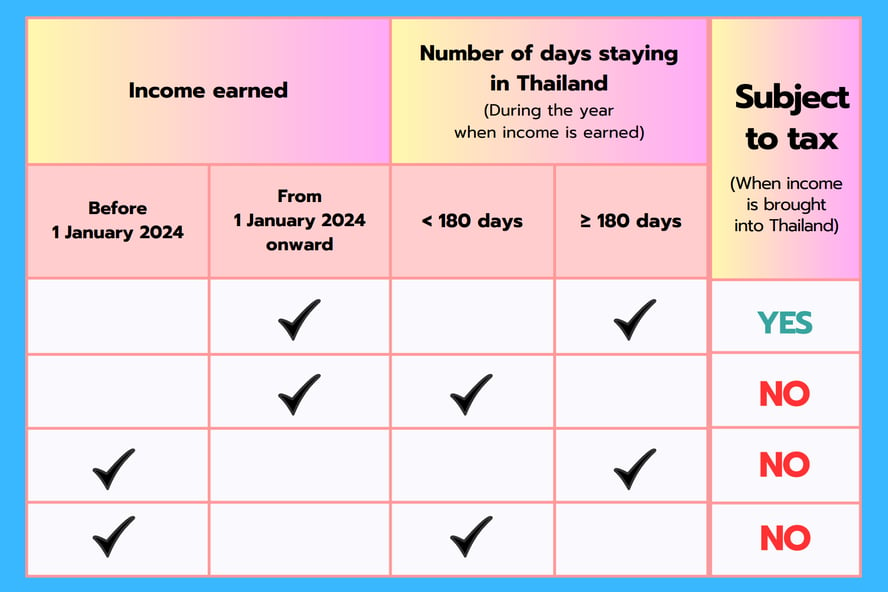
Image table from HOW DO FOREIGNERS LIVING IN THAILAND PAY TAX?
Spend 180 days or more in Thailand and you are generally considered a Thai tax resident. Thailand has tightened rules from 2024 onwards, taxing not only Thai-source income but also foreign income that is remitted into Thailand.
That means dividends, director’s fees or even sale proceeds from your Singapore company can become taxable if you bring them into a Thai bank account while resident.
There is another layer. If you are effectively managing your Singapore business from Thailand, you may create “management and control” or even permanent establishment risks. That has implications under both Singapore and Thai tax rules.
Semi-retirement is a strategic transition, not a casual relocation.
2. Choose a Visa That Matches Reality
The standard retirement visas, Non-Immigrant O or O-A for those aged 50 and above, are still the simplest pathway.
Financially, the typical requirements are:
- SGD$30,400 (800,000 THB) in a Thai bank account or
- SGD$2,470 per month (65,000 THB) in income or
- A combination meeting SGD$30,400 (800,000 THB) annually
For O-A visas, health insurance of around SGD$114,000 (3,000,000 THB) or USD$100,000 minimum cover is often required.
But these visas are designed for people who are no longer actively working. They prohibit employment in Thailand.
A semi-retired owner usually considers one of three approaches:
- Live on retirement status while being paid only from Singapore sources
- Explore Long-Term Resident categories aimed at wealthy individuals or professionals
- Maintain separate work-authorised status if actively involved in a Thai entity
The key principle is alignment. If you are managing Thai staff or servicing Thai clients, a pure “retirement” label may not reflect your actual activity.
Immigration status must match behaviour.
3. Structure Income and Remittances Carefully
The Singapore–Thailand Double Taxation Avoidance Agreement is your main protection against being taxed twice.
It allocates taxing rights over business profits, dividends, interest and royalties, and caps certain withholding taxes. But the treaty does not eliminate tax automatically. It requires structure and documentation.
Semi-retired founders typically focus on:
- Clear separation of Singapore-source business income
- Evidence of where management and control sit
- Proper tax residency certificates
- Controlled timing of remittances into Thailand
A common strategy is simple in concept. Only remit what you need for living expenses in Thailand. Keep larger investment pools or accumulated dividends outside Thailand if possible.
This turns Thailand into a lifestyle base without unnecessarily expanding your Thai tax footprint.
But this must be planned with advisers who understand both jurisdictions.
4. Build a Dual-Layer Insurance Strategy
Because you still travel for board meetings, deals and portfolio oversight, a basic local retiree policy is rarely enough.
Many semi-retired owners maintain:
- A robust Singapore or international health plan for high-end treatment in Singapore or regionally
- A Thai-issued policy that satisfies visa requirements, such as SGD$114,000 (3,000,000 THB) or USD$100,000 minimum cover for O-A
One policy satisfies immigration compliance.
The other protects your actual lifestyle and mobility.
This dual-layer structure gives you flexibility without compromising regulatory requirements.
5. Design the Transition, Do Not Drift Into It

The most successful semi-retirements are mapped out three to five years ahead.
You define:
- How many days you will spend in Thailand
- How you will be paid from your Singapore structures
- How much you need to remit annually
- Whether board meetings and management decisions remain clearly anchored in Singapore
Thailand should not just be a cheaper place to live.
It can be a strategic hub in your regional wealth plan. A place where you operate as a full-time owner and investor rather than a full-time operator.
Semi-retirement, done properly, is not an exit.
It is a controlled upgrade in how you deploy your time, capital and energy.
And like any business move, the winners are those who plan before they relocate.
References:
- Dayva, "Thailand Guide"
- HLB Thailand, "New Rule for Taxation of Foreign Income"
- Expat Tax Thailand, "Thailand Tax Essentials for Expats: An Easy-to-Follow Annual Guide"
- Thai Embassy, "Thailand Retirement Visa"
- Siam Legal, "Thailand Retirement Visa"
- G.A.M. Legal Alliance, "Retirement Visa Financial Requirements"
- Corporate Services Singapore, "Thailand–Singapore DTAA Guide"
- Mahanakorn Partners, "The Singapore–Thailand Double Taxation Avoidance Treaty"
Let us know what you think about this topic, and what do you want to hear next.
You can now be our community contributor and make a pitch to have your favourite personality be on our show.
Join our community group and drop us your insights on this topic.






Let us know what you think of this post