
-3.png?width=50&name=Square%20(2)-3.png)

Vice Premier He Lifeng walked into the 2026 Lujiazui Forum on Wednesday and delivered Beijing’s clearest signal yet that the yuan must stop being a regional payments afterthought and start behaving like a global reserve currency. For Singapore-based professionals whose bonuses, property purchases and offshore wealth sit in Singapore dollars, the announcement carries real currency-risk, regional-allocation and cross-border product implications from MAS’s deepening China partnership.
Beijing’s opening salvo
At the annual forum, the first in-person appearance by a Central Government Vice Premier in seven years, He Lifeng framed the package unmistakably:
“China will continue to steadily expand institutional opening-up in the financial sector,”
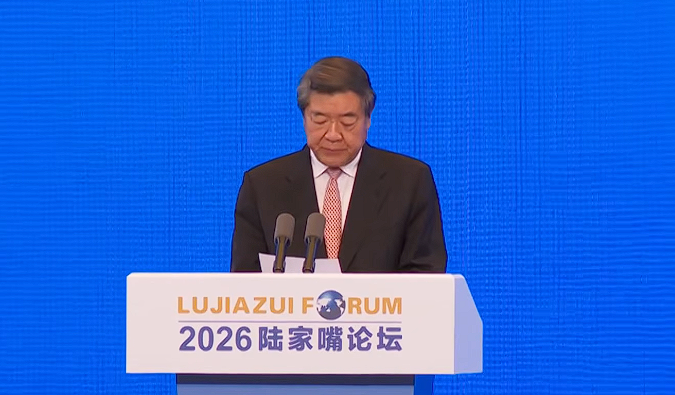
and pledged that Beijing is “ready to improve cooperation on global financial governance and work with all parties to address risks and challenges.”
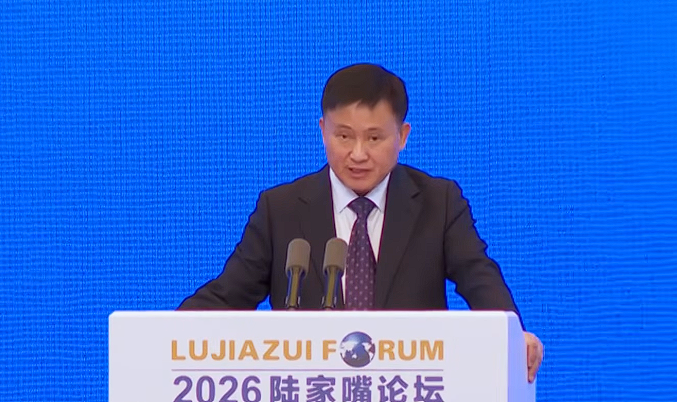
The forum’s headline act, however, came from People’s Bank of China (PBOC) Governor Pan Gongsheng, who rolled out eight new pilot measures, including an offshore finance action plan, a new digital-RMB international operations centre, a renminbi repo facility for overseas central banks, sovereign wealth funds and international financial organisations, and onshore-offshore RMB forex trading.
Pan Gongsheng, punctuating the package with this observation:
“RMB internationalisation has made solid progress, which has provided domestic and overseas entities with more diversified currency options… We will continue to improve the institutional arrangements and financial infrastructure for the cross-border use of RMB.”
A separate 300 billion yuan (approximately S$55.1 billion, at 1 RMB equals roughly S$0.1837) tranche of special bonds was also announced to recapitalise major state-owned banks, a familiar Beijing playbook that funnels balance-sheet capacity into credit channels.
What the data currently shows
Headlines aside, the yuan remains marginal outside China. In September 2025 SWIFT data put the RMB at 3.17 per cent of global payments, sixth behind the US dollar, euro, pound, yen and Canadian dollar. Hong Kong cleared 75.6 per cent of offshore volume, the UK 6.42 per cent, and Singapore 3.81 per cent. The IMF’s COFER tally puts RMB global FX reserves below 3 per cent against the dollar’s roughly 58 per cent. So the push is incremental, not revolutionary: the yuan is gaining ground on the margins rather than displacing greenbacks anytime soon.
Why Singapore matters more than London
This is where the Lujiazui package meets Singapore directly. MAS and the PBOC announced new initiatives at the 21st Joint Council for Bilateral Cooperation in Chongqing on 15 December 2025, including the appointment of DBS Bank as Singapore’s second RMB clearing bank alongside ICBC, support for secondary listings of A-share companies on the SGX, an OTC China Interbank Bond Market access arrangement via Bank of China and DBS, and an e-CNY wallet pilot for Singapore travellers.

In its own December 2025 release, MAS Managing Director Chia Der Jiun put the strategic case in plain terms:
“The deepening financial connectivity between Singapore and China has supported the growth of cross border trade and investment linkages between our economies.”
Rough arithmetic from public sources: Singapore clears roughly RMB 9.7 trillion (approximately S$1.78 trillion) annually, holds RMB 276 billion in deposits, and is the world’s third-largest FX centre. Add DBS as a second clearing bank plus the e-CNY pilot, and you have a credible infrastructure stack for a Singapore-based professional seeking RMB exposure without routing through Hong Kong.
What this means for your money
Three practical inferences for Singapore-anchored professionals:
First - multi-currency cash management just got easier.
With DBS handling RMB clearing on the ground here and an OTC bond market link via Bank of China, corporate Singapore can hold working-capital balances in RMB-cost structures more cheaply, easing offshore bill discounting and trade finance pricing.
Second - the yuan is still a satellite, not a sun.
At a 3.17 per cent SWIFT share and sub-3 per cent reserve share, RMB remains a diversification tool, not a core reserve. UBS’s Global Wealth Management CIO rates the CNY as “Attractive within our global currency preferences and favour[s] adding CNY exposure to USD-based portfolios for currency diversification,” a hedge allocation, not a wholesale swap.
Third - watch the AML and capital-flow rulebook.
Pan Gongsheng’s eight measures and SAFE’s parallel reforms under Zhu Hexin are about making RMB plumbing more efficient; they are not about opening the capital account. Cross-border RMB business in Singapore will still be a tightly managed corridor, with limits on retail convertibility and FX hedging.
The takeaway for Singaporean reader
Beijing doubling down on the yuan matters because Singapore has chosen to monetise it rather than resist. MAS is effectively Singapore’s most aggressive RMB infrastructure builder. The play for the high-earning professional is straightforward: use Singapore as your RMB entry and exit ramp, but keep the bulk of the portfolio in Singapore-dollar and dollar assets until Beijing loosens the capital account, which, on Lujiazui 2026 evidence, is still some way off.
Let us know what you think about this topic, and what do you want to hear next.
Source referenced:
-
Global Times, China unveils high-level financial opening-up policies at Lujiazui Forum
-
State Council of the People’s Republic of China, China's vision for deeper financial opening-up highlighted at Shanghai Lujiazui Forum
-
BIS Central Bank speeches, China's high-quality development and global economic rebalancing
-
Caixin Global, China to Issue 300 Billion Yuan Bonds to Boost Big State Banks
-
SWIFT, RMB Tracker, July 2025; Global Times, Use of Chinese yuan reaches 3.17 per cent in global payments in September
-
Reuters, Yuan, Aussie dollar gain share of global reserves, dollar dips, IMF data shows
-
Monetary Authority of Singapore, Singapore and China Deepen Financial Cooperation through New RMB and Capital Market Initiatives
-
ORCA Asia, Singapore and the Yuan
You can now be our community contributor and make a pitch to have your favourite personality be on our show.
Join our community group and drop us your insights on this topic.




Let us know what you think of this post