
-Jun-01-2025-06-24-42-9139-PM.png?width=50&name=Square%20(2)-Jun-01-2025-06-24-42-9139-PM.png)

Chubby FIRE at S$6 million is not a meme. It is a real target that many high earners are actively approaching, debating, or living with. Yet the number alone rarely answers the real question: can I actually stop working?
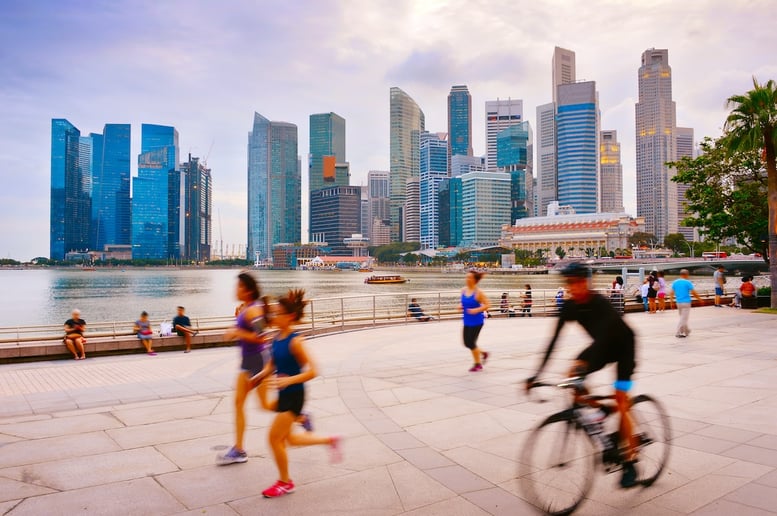
The stories below show a pattern. The portfolio math often works at S$6 million. The hesitation is emotional.
A Quick Singapore Context
The examples referenced originate from US-based FIRE discussions and are converted using roughly 1 USD to 1.35 SGD. That places S$6 million at about US$4.4 million.
Cost structures differ. Housing in a prime Singapore district can rival or exceed many US cities. Public transport and local food can be cheaper. Healthcare and education choices vary widely depending on whether one chooses public or private options.
In broad terms, S$6 million at a 3 to 4 percent withdrawal rate supports about S$180,000 to S$240,000 per year. In Singapore, that comfortably funds a high-quality lifestyle unless multiple premium expenses are layered together at once.
The more interesting question is whether that spending level feels secure enough.
Story 1: Crossing S$6 Million and Still Unsure
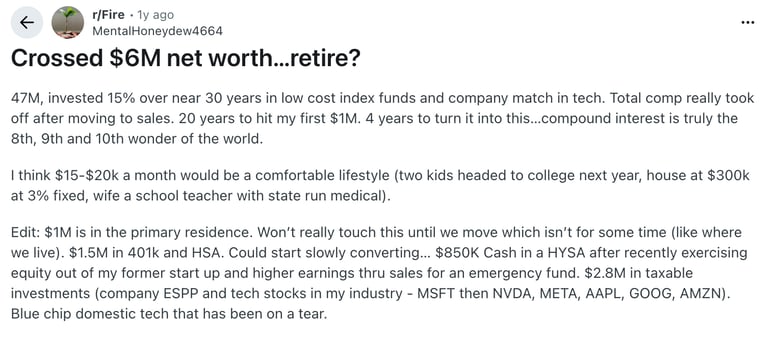
One 47-year-old tech sales professional reported reaching about US$4.4 million, or roughly S$6 million, after nearly three decades of investing 15 percent of his income into low-cost index funds and company stock. His compensation accelerated significantly once he moved into enterprise sales.
His household estimated that S$15,000 to S$20,000 per month would comfortably support their family, including two children heading to university. On paper, S$6 million could sustain that spending under a 3 to 4 percent withdrawal framework.
His balance sheet looked typical of high earners in expensive cities: meaningful home equity, diversified retirement accounts, taxable investments heavily weighted toward large-cap technology, and a sizeable cash reserve.
Yet his post was not celebratory. It was cautious. The financial independence math worked. The psychological step away from a high-status, high-income career did not feel automatic.
Story 2: Similar Assets, Different Decision
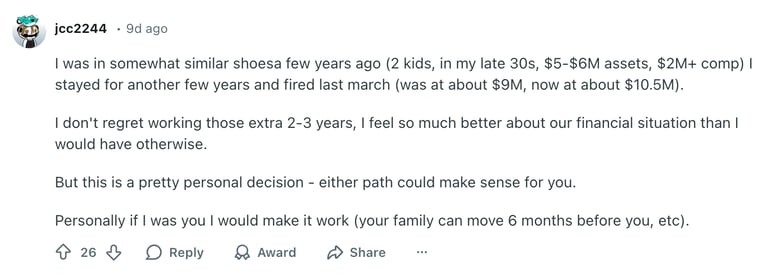
Another commenter described being in a similar position in his late 30s, with two children and total assets around S$6.7 million to S$8.1 million. His peak annual compensation exceeded S$2.7 million.
Instead of stopping near the S$6 million mark, he worked an additional two to three years and eventually exited with assets closer to S$12 million or more.
Looking back, he felt the extra buffer significantly reduced anxiety about market downturns, healthcare costs, and education expenses. He emphasised that both choices could be rational. His decision reflected comfort, not necessity.
This dynamic resonates in Singapore. When housing, schooling, and long-term healthcare costs are substantial, overshooting a target often feels safer than landing exactly on it.
Story 3: Laid Off Into FIRE
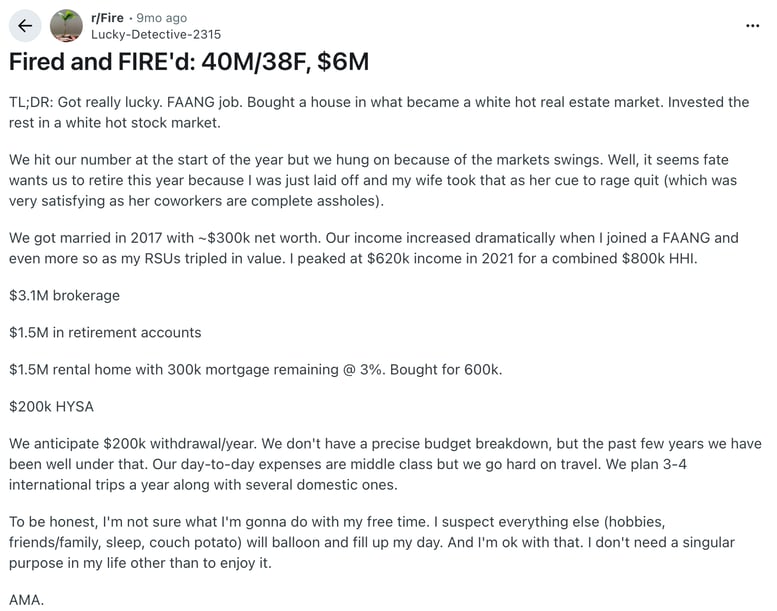
Another couple in their early 40s reached approximately S$6 million through rising tech compensation, stock grants, disciplined investing, and favourable markets. A layoff forced their decision.
Instead of immediately returning to corporate roles, they examined their portfolio. Their assets could support annual withdrawals of roughly S$270,000 while remaining below a 4 percent rate.
Their lifestyle was described as comfortable and travel-heavy rather than extravagant. Multiple international trips each year. Stable housing. No excessive luxury layering.
Interestingly, the husband admitted uncertainty about how to fill unlimited free time. Yet he did not regret stepping away. Financial independence gave him optionality. Purpose could evolve.
Story 4: Overfunding for Certainty
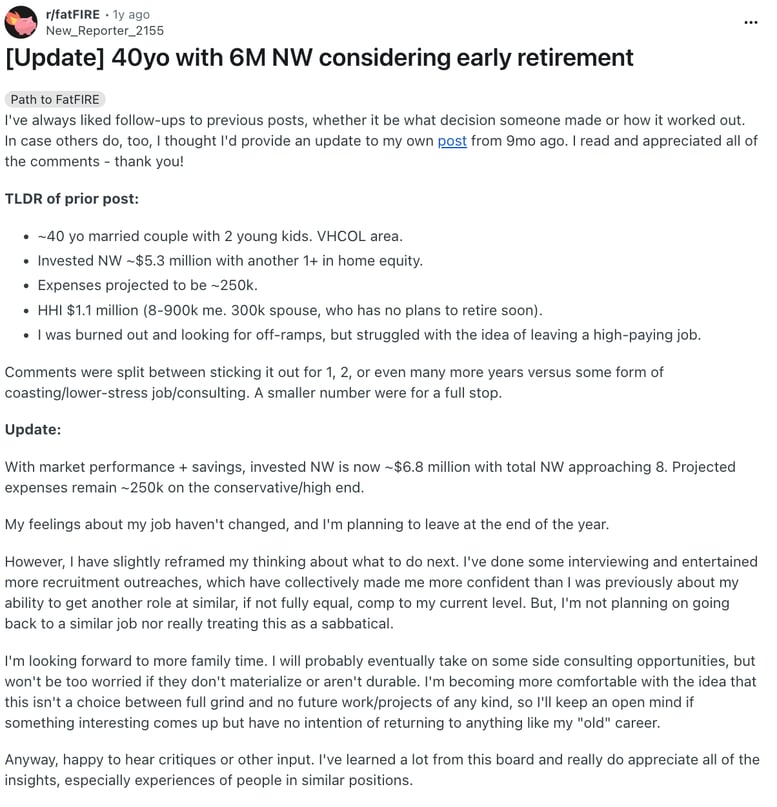
A fourth case involved a couple with invested assets around S$7.2 million and total net worth exceeding S$8 million, with projected spending of about S$340,000 annually.
They debated whether to endure a demanding role for a few more years. Subsequent market gains and continued saving pushed invested assets above S$9 million.
That larger cushion shifted the emotional equation. The higher-earning spouse exited full-time work and reframed the future around family time and selective consulting.
The difference between S$6 million and S$9 million did not fundamentally change their lifestyle. It changed their perceived safety margin.
What This Means for Singapore
Across these examples, several patterns repeat:
- Long careers in high-paying sectors
- Consistent investing into diversified funds and equity
- Late-career income surges accelerating net worth
- Annual spending targets between S$180,000 and S$340,000
In Singapore, S$6 million can comfortably support an upper-middle to lower-luxury lifestyle, particularly if housing, cars, and schooling choices are intentional rather than automatic upgrades.
The larger insight is behavioural. Some retire the moment the math works. Others extend their careers for emotional security. Some are pushed into FIRE by circumstance and discover it works.
At S$6 million, the constraint is rarely arithmetic. It is comfort with uncertainty.
For Singaporeans aiming at Chubby FIRE, the number is only half the equation. The other half is deciding how much buffer makes you sleep well at night. Because as these stories show, “enough” is not purely a figure on a spreadsheet. It is a threshold of confidence.
Sourced consulted:
- Reddit (r/Fire) — Crossed $6M net worth/retire?
- Reddit (r/ChubbyFIRE) — 6M and thinking about next steps — would love advice
- Reddit (r/Fire) — Fired and FIRED — 40M38F, 6M
- Reddit (r/fatFIRE) — Update — 40yo with $6M NW considering early…
- I Will Teach You To Be Rich — ChubbyFIRE
Let us know what you think about this topic, and what do you want to hear next.
You can now be our community contributor and make a pitch to have your favourite personality be on our show.
Join our community group and drop us your insights on this topic.






Let us know what you think of this post