
-Jun-01-2025-06-24-42-9139-PM.png?width=50&name=Square%20(2)-Jun-01-2025-06-24-42-9139-PM.png)

Families in Singapore can achieve FAT FIRE. But only under very specific conditions: very high and stable incomes, disciplined investing over decades, and deliberate lifestyle choices around housing, cars, and education.
The maths is not impossible. It is simply unforgiving.
What FAT FIRE Means for a Singapore Family

For a family with children, FAT FIRE usually means retiring early while still living at an upper-middle-class standard or above. That might include:
- Private condo or landed housing
- At least one car
- Regular overseas holidays
- Enrichment classes and tuition
- Insurance coverage with buffers
- Not worrying about routine expenses
Cost-of-living breakdowns commonly place a “comfortable” family life in Singapore at around S$6,000–S$12,000 per month, depending mainly on housing and schooling.
A published “middle-income FatFIRE” case study for a family of three budgets S$20,000 per month, or S$240,000 annually, for a three-bedroom East Coast condo, a Tesla, travel, food, insurance, school fees and a helper.
Using a 4% withdrawal rule, S$240,000 per year implies a portfolio of about S$6 million.
If spending rises further: international schools, landed property, business-class travel, required assets can quickly approach eight figures.
Why Kids Change the Equation
Children amplify fixed costs in ways that are difficult to reverse.
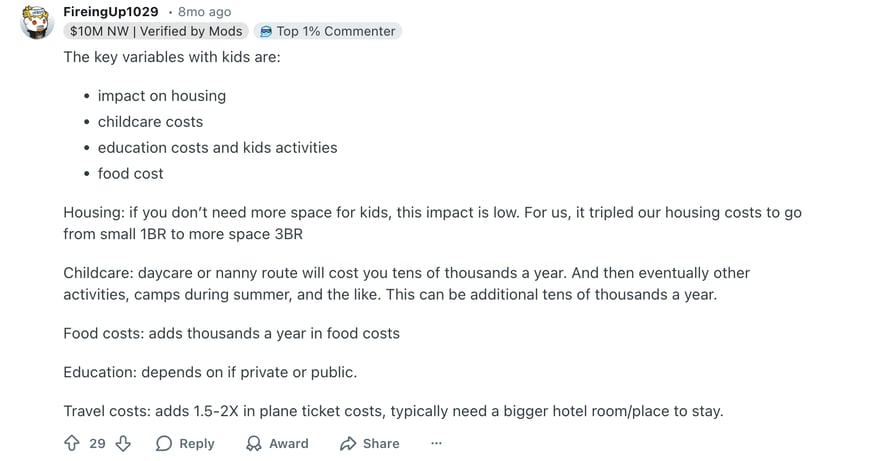
Housing expands first. A couple may live comfortably in a small apartment, but a family typically moves to a three-bedroom condo or larger flat. In many areas, that alone can push monthly housing costs into the S$3,000–S$10,000 range.
Childcare and domestic support add another layer. Full-day childcare can exceed S$2,000 per month. A live-in helper adds roughly S$800 monthly before levy and other expenses.
Education costs vary dramatically. Public schooling is manageable, but international schools often range from S$17,000 to S$40,000+ per child annually, excluding enrichment and extracurricular activities.
Travel multiplies too. Airfares, larger hotel rooms and higher dining bills mean holidays can cost 1.5 to 2 times more than they did before children.
Individually, these categories seem manageable. Together, they materially raise the baseline spending required to sustain a “FAT” lifestyle.
The Portfolio Math
Take the S$240,000 annual spending example. At a 4% withdrawal rate, the portfolio target is S$6 million.
Even at a strong household income of S$400,000 per year, saving S$200,000 annually requires a 50% savings rate while raising children. Assuming reasonable market returns, it could still take two to three decades to accumulate S$6 million.
Now compare this to more typical household incomes. Many families earn far below S$400,000 annually. Saving S$200,000 a year is simply unrealistic for most.
That is why true early FAT FIRE with children in Singapore is rare. It requires a combination of:
- High dual incomes or successful entrepreneurship
- Long periods of disciplined saving
- Avoidance of excessive lifestyle inflation
For most families, the realistic endpoint is not FAT FIRE in their 30s. It is financial independence closer to their late 40s or 50s.
What It Takes If You Still Want It

For families serious about FAT FIRE, the approach has to be almost clinical.
First, maximise earning power. Two high-income careers or a business generating substantial cash flow are often necessary. Combined mid-six-figure income dramatically improves feasibility.
Second, be deliberate with housing and cars. Choosing HDB or a modest condo early on allows capital to compound instead of being locked into large mortgages. Delaying car ownership reduces long-term cash outflow.
Third, control “kid inflation.” Public or neighbourhood schools, capped enrichment budgets and pragmatic travel choices can preserve six figures of capital over time.
Fourth, invest aggressively but prudently. A diversified portfolio of global equities, REITs and bonds is typically the engine. CPF provides a future safety floor, but it rarely drives FAT FIRE on its own.
Finally, adjust expectations. With children and Singapore’s cost structure, “early” retirement may realistically mean 50 rather than 35.
So Is It Possible?
Yes. Singapore families with children can reach FAT FIRE.
But it is uncommon. It generally belongs to families combining very high incomes, consistent investing discipline, and controlled lifestyle choices over many years.
For everyone else, a hybrid path often emerges: strong financial independence, perhaps some ongoing work by choice, and a very comfortable lifestyle that may not meet every “FAT” definition but still provides security and flexibility.
In Singapore, the constraint is not ambition. It is arithmetic.
Understanding that early makes the journey clearer, and far less romantic, but far more realistic.
- My 15 Hour Work Week, "FatFIRE for a Family of 3 in Year 2025"
- Fidelity, "What Is Fat FIRE?"
- SG Financial Advice, "How Expensive Is Life in Singapore in 2025? A Complete Cost of Living Breakdown"
- Investopedia, "Financial Independence, Retire Early (FIRE)"
Let us know what you think about this topic, and what do you want to hear next.
You can now be our community contributor and make a pitch to have your favourite personality be on our show.
Join our community group and drop us your insights on this topic.




Let us know what you think of this post