
-Jun-01-2025-06-24-42-9139-PM.png?width=50&name=Square%20(2)-Jun-01-2025-06-24-42-9139-PM.png)

Singaporeans who are pursuing FIRE, healthcare is the variable that rarely shows up dramatically in spreadsheets, but can quietly determine whether a plan holds or unravels.
Healthcare should not be treated like groceries or travel. It behaves differently. Costs rise faster, risks are uneven, and timing matters. A useful way to think about it is to divide your planning into two phases: the pre-65 “bridge years” and the post-65 CPF LIFE phase, then layer in realistic assumptions about medical inflation.
The pre-65 “bridge years”

These are the years after stepping away from full-time employment but before CPF LIFE payouts begin. During this phase, most healthcare spending comes directly from your portfolio or CPF balances.
Protection usually rests on three layers: MediShield Life, any Integrated Shield Plan (IP) you’ve chosen, and riders that reduce deductibles or co-insurance. While MediShield Life provides baseline coverage, many FIRE aspirants opt for IPs that cover B1/A wards or private hospitals for greater choice.
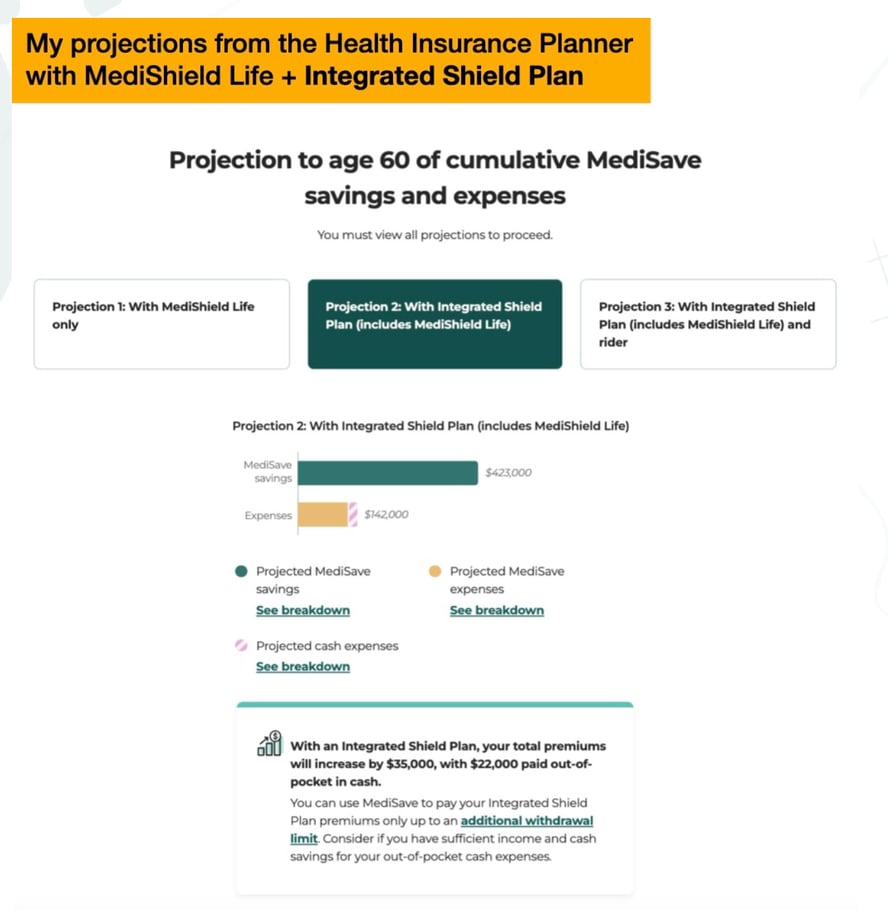
One practical reality: IP premiums rise significantly with age, and a growing portion must be paid in cash rather than MediSave. Your 50s and early 60s can therefore be surprisingly expensive from an insurance perspective. Routine GP visits, specialist consultations, dental care, and screenings add another steady stream of out-of-pocket costs.
A reasonable working estimate for the bridge years might look like this per adult:
- S$3,000–S$5,000 annually for insurance premiums and riders
- S$1,000–S$2,000 for routine out-of-pocket healthcare
This suggests a planning range of roughly S$4,000–S$7,000 per person per year, excluding major one-off medical events.
The goal is not precision. It is to ensure healthcare is explicitly modelled rather than absorbed into a vague “miscellaneous” category.
The post-65 CPF LIFE phase
At 65, the financial structure shifts. CPF LIFE payouts begin for most Singaporeans, providing a base income stream. There are also more targeted senior subsidies and support schemes.
MediShield Life premiums are higher in older age bands, but premium subsidies and MediSave usage help offset part of the cost. CareShield Life provides monthly payouts if severe disability occurs, easing some long-term care exposure.
However, healthcare does not necessarily become cheaper. Chronic conditions tend to accumulate, increasing medication and specialist costs. Couples must also decide whether to maintain their IP coverage level, downgrade to subsidised ward coverage to save on premiums, or rely solely on MediShield Life.
A reasonable “normal year” estimate per senior might be:
- S$2,500–S$4,000 in net premiums (after MediSave and typical subsidies)
- S$1,500–S$2,500 for outpatient care, medication, and dental
This points to a planning range of roughly S$4,000–S$6,500 per person per year, separate from any long-term care event.
Long-term care remains the largest tail risk. Supporting severe disability can cost thousands per month for extended periods. Insurance and CareShield Life mitigate this risk, but it should not be ignored entirely.
Premium inflation: a separate assumption
One common mistake in FIRE planning is applying the same inflation rate to all expenses. Healthcare deserves its own lane.
Medical costs in Singapore have historically risen faster than general prices. Insurers periodically adjust premiums as claims and treatment costs increase. A prudent approach is to model:
- General living expenses at 2–3% annual inflation
- Healthcare at 3–5% annually, with stress testing at higher levels if risk-averse
This alone may justify a more conservative withdrawal rate — closer to 3–3.5% rather than the traditional 4%.
Turning healthcare into a deliberate line item
A simple rule of thumb is to allocate an additional 10–20% on top of baseline retirement spending specifically for healthcare and potential long-term care.
Within that:
- Pre-65: S$4,000–S$7,000 per person annually
- Post-65: S$4,000–S$6,500 per person annually, plus long-term care protection
The exact figure will vary depending on health, insurance choices, private versus public care preferences, and subsidy eligibility.
The objective is not to forecast every bill. It is to acknowledge that in Singapore, healthcare is a structural cost centre in early retirement. A realistic FIRE plan gives it its own line, its own inflation assumption, and its own margin for error.
That margin; more than any single number, is what makes early retirement sustainable rather than speculative.
References:
- Singlife, "MediShield Life & ElderShield: Same Same But Different"
- CPF, "How Much Health Coverage Is Enough"
- CPF, "How Much Does Health Insurance in Singapore Cost"
- Great Eastern Life, "Are You Retirement Ready 2026 Singapore"
- StashAway, "How Much to Retire in Singapore"
- SG Budget Babe, "Rethinking Health Insurance Costs"
Let us know what you think about this topic, and what do you want to hear next.
You can now be our community contributor and make a pitch to have your favourite personality be on our show.
Join our community group and drop us your insights on this topic.




Let us know what you think of this post